Copilot Rank Tracking Tools: 9 Compared, and Why There Is No Rank
Nine copilot rank tracking tools compared on which plan actually includes Microsoft Copilot, what each one stores, how it behaves across a client roster, and what it costs - every cell checked against the vendor's own page, with the page we read and the date we read it beside it.
TL;DR: Copilot rank tracking is a shopping term, not a measurement: Microsoft Copilot returns one written answer with numbered sources, so there is no ordered result list to hold a position in. What you can measure is whether the brand was named in the prose and whether its own domain appeared in the sources - so every rank tracking tool Copilot buyers shortlist is really selling one of those two facts, or a proxy for one. Some roundups already give the tier that carries Copilot its own table column - one of them names the column exactly that - but none of the three we read puts the vendor page and the date it was read into the cell with the price. Checked 2026-09-14, and 2026-09-11 for Otterly: Otterly.AI carries Copilot in every published tier from $29 a month, AthenaHQ names it on a free tier and on its $295 Starter, Peec AI sells it as a $35-a-month extra model on a $95 Starter, Rankability puts it on the $399 Team plan or à la carte, LLM Pulse charges from €10 a month per model on top, and Profound and Dageno keep it on custom-priced tiers. Bing Webmaster Tools gives you real Copilot citation data for your own site, free.
Roundups for this query compare engine counts and headline prices, and the better ones warn you in prose that "supports Microsoft Copilot" and "includes Microsoft Copilot in the plan you can afford" are different statements. Three of the ones we read go further and give the answer its own table column: ZeroRank's is called Cheapest plan with Copilot and carries a figure in six of its seven rows, Dageno's nine-tool table has one for Microsoft Copilot coverage, and LLM Pulse's has one for starting price - all three read 2026-09-14. Source links inside those cells, counted the same day: ZeroRank 0 across its seven rows, under a 19 August byline; Dageno 1 across nine rows, under an 11 September stamp; LLM Pulse 0, under a 30 August line. Each of those dates is a page byline covering the whole table. The table on this page puts the vendor URL and the day we opened it inside every cell instead. It matters: several vendors make the broad claim on a product page and the narrow one on their pricing page, and one of the nine pricing pages below stopped existing between our two readings. The table reconciles all of that, cell by cell, with the page and the day we read it in the cell.
This page is about choosing software. For the manual version you can run this afternoon with a browser and a spreadsheet, read how to track brand mentions in Microsoft Copilot. For the other two single-surface shortlists, see best Google AI Mode tracking tools and best Google AI Overview trackers. For the whole category rather than one engine, see the AI visibility tool shortlist for agencies.
Is there a rank in Copilot answers?
No, and the vendors mostly agree, which makes the naming odd. Copilot answers a question in prose and attaches numbered source cards. There is no list of ten results, so there is no position one. A product reporting your "Copilot rank" is doing one of three things: reporting where your brand name falls in the order of brands the answer happens to mention, reporting a proprietary prominence score with no external definition, or - at least in how some of these products are marketed - reporting your Bing web ranking underneath the same query. All three are real numbers. None of them is a rank in the sense a client hears, and a client who finds that out later discounts the rest of the report.
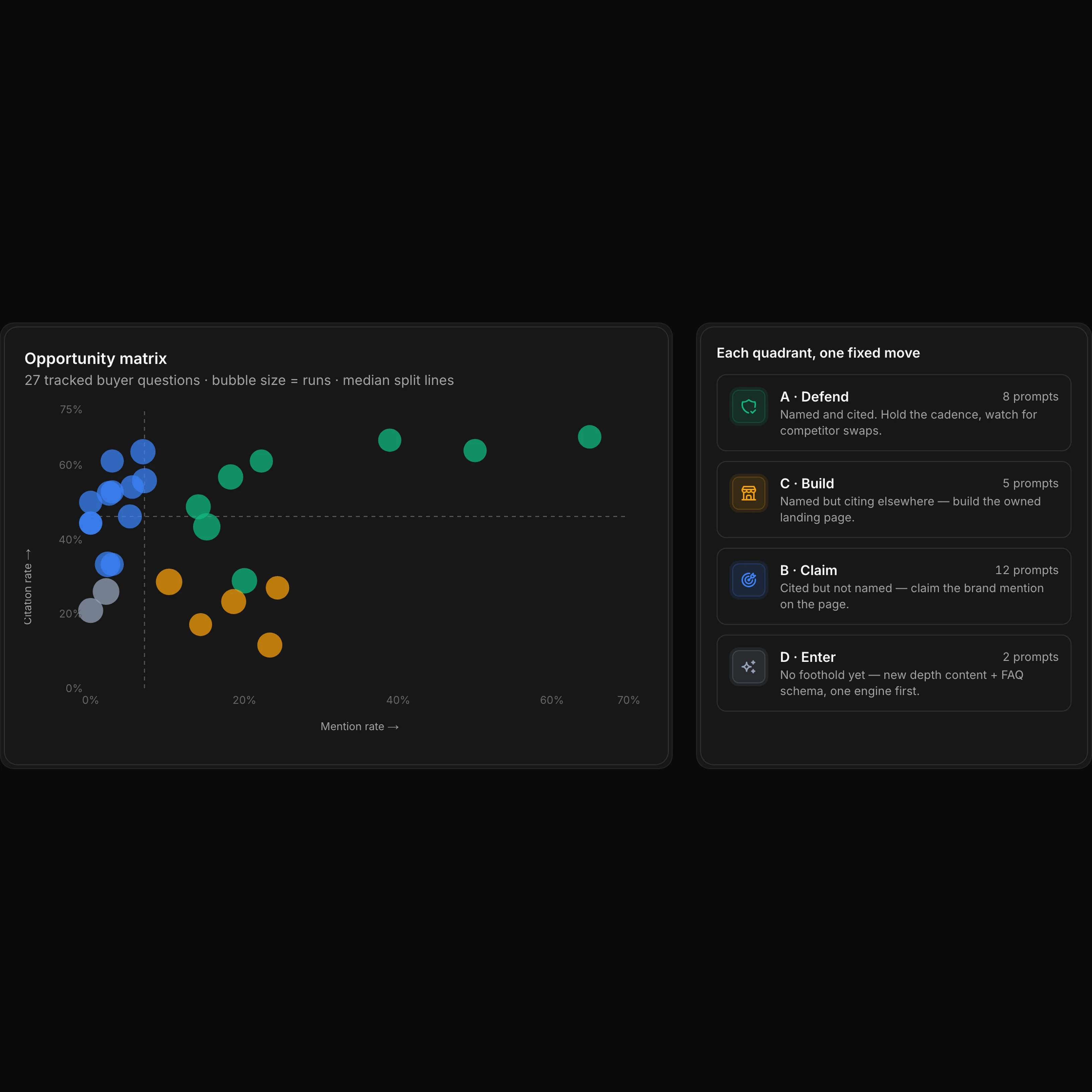
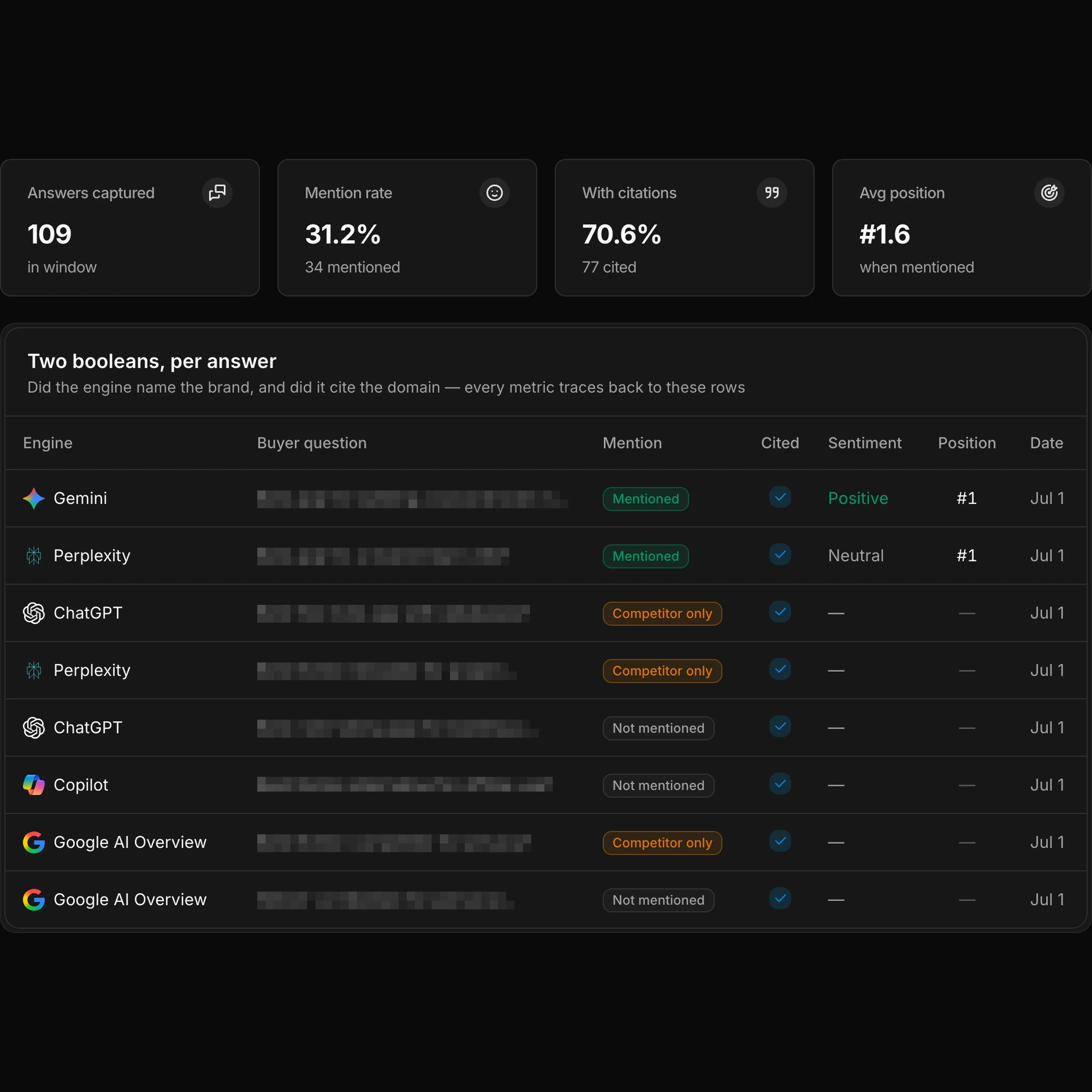
Two facts survive scrutiny on every sampled answer, and we keep them in separate columns forever:
- Named - did Copilot write the brand into the prose the reader sees? Yes or no.
- Cited - was the brand's own domain among the numbered sources under the answer? Yes or no.
They fail for different reasons and get fixed different ways, which is why merging them into one visibility percentage destroys the only signal worth acting on. The long version is in mention vs citation and evidence, not a score.
What a "rank tracking tool Copilot" search is actually shopping for
The phrase people type is a rank tracking tool; the thing on sale is one of two different products, and the price gap between them is the reason this page exists.
The first shape is a keyword rank tracker with a Copilot column bolted on. It already has your keyword set, your Bing and Google positions and your client reporting, and Copilot arrives as one more line in the same grid. Rankability and Dageno sit here. The number it hands you is either a within-answer ordering or a Bing web position, and it fits the report your client already reads.
The second shape is an answer monitor. It runs a fixed prompt set, keeps what Copilot wrote back, and scores each answer on the two booleans above rather than a position. Peec AI, LLM Pulse, Siftly, AthenaHQ and Jincove sit here. The number is harder to put in a rank column and much easier to defend when a client asks what it means.
Neither shape produces a rank in the search sense. Decide which one your report needs before you compare prices, because the two are not substitutes and the cheapest plan carrying Copilot differs between them by hundreds of dollars a month.
There is a second thing to pin down before you compare products: which Copilot. The public web experience, the Edge sidebar and Microsoft 365 Copilot are not the same surface. Rankability's Copilot page opens on Copilot drawing on a company's Microsoft 365 data through Microsoft Graph (rankability.com/microsoft-copilot-rank-tracker, checked 2026-09-11 and again 2026-09-14) - and then answers the obvious question in its own FAQ: it queries publicly accessible Copilot answers and leaves the Microsoft 365 tenant untouched. That is the right answer, and it is the answer to demand from every vendor on this page, because the tenant grounding material is not the web and no external sampler can see it.
How we picked, and where we are biased
Jincove is our own product. It is on this list, near the bottom, with a paragraph on who should not buy it. Rubric first, so you can re-run it against anything we left out.
- Which plan names Microsoft Copilot - not which product page mentions it.
- What a run stores - the answer text and its sources, or a chart.
- Whether named and cited stay apart rather than averaging into one score.
- What it does across a roster, not on one brand.
- Whether the price is published at all.
Every figure below is what the vendor's own page showed when we opened it, and the last column names that page and the day we read it. We read all nine on 2026-09-11 and went back to every one of them on 2026-09-14; two cells still carry the earlier date, and both say why. Prices are the monthly figure the page showed on load, with the annual equivalent in brackets wherever the page prints one - where a page offers an annual discount but only prints a yearly total, or only a badge promising two free months, we give you that instead of doing the arithmetic on the vendor's behalf. Where a figure lives in an add-on table rather than a plan card we name the table. Where a figure is served by the page's script bundle rather than its HTML we say that too, because a plain fetch showing no price is a fact about the fetch, not about the vendor. We ran no controlled comparison of sampling quality, so nothing here claims one tool reads Copilot more accurately than another.
One product we left out and why: Scrunch AI, because its pricing page gave us two different engine lists on the same day - one reading listed a four-LLM entry tier at $250 that included Copilot, a later reading listed seven platforms without it (scrunch.com/pricing, both 2026-09-11) - so we could not state its Copilot coverage honestly.
The nine copilot rank tracking tools compared
| Tool | Where Copilot sits | Cheapest plan naming Copilot | Answer text stored | Across a roster | Page we checked, and when |
|---|---|---|---|---|---|
| Otterly.AI | One of four base engines on every tier | Lite, $29/mo ($25 billed annually), 15 prompts | Not stated on the pages we read | Agency page claims client workspaces with no per-client fee; the prompt quota is the real cap | otterly.ai/pricing · read 2026-09-11; on 2026-09-14 the same URL answered with a bot challenge instead of a page |
| Peec AI | Listed for every tier - but self-serve tiers include three active models at a time | Starter, $95/mo ($80 billed annually), 50 prompts - plus $35/mo for one extra model if Copilot is not one of your three | Charts are the primary output | Brand tiers cap projects at 1 / 2 / 5; a separate agency page prices by configuration | peec.ai/pricing · read 2026-09-14; the figures are served by the page's script modules, not its HTML |
| Rankability | Team tier, or à la carte on a lower tier, despite a dedicated Copilot product page | Team, $399/mo ($332 billed annually), 250 prompts; the à la carte route carried no price | Not stated on the pages we read | 1 / 3 / 10 brand workspaces, unlimited seats | rankability.com/pricing · read 2026-09-11; by 2026-09-14 that URL redirected to a demo form, so the tiers below come from the earlier reading |
| AthenaHQ | Named on the free Essential card, one of five engines, and on Starter, one of eleven | Essential, free - $25 of credit, 300 credits, Copilot among the five; Starter is $295/mo ($245 billed annually) for 3,600 credits (1 credit = 1 AI response) | Not stated on the plans page; the free tier lists prompt and response analysis | Starter is sold for "Self-Guided SMBs"; agencies are pointed at Enterprise | athenahq.ai/plans · read 2026-09-14 |
| Siftly | Its own named Copilot tracking page | プロプラン, ¥33,000/mo (税込), with a ¥0 スタートプラン above it, on the page siftly.ai/pricing redirects to; USD equivalent MISSING — three routes tried 2026-09-14, listed below | Lists prompt, brand order, cited sources and answer summary as report fields | MISSING — as of 2026-09-14 not readable via the static HTML including aria-label, the six JavaScript files the page loads, or any toggle on it | siftly.ai/features/rank-tracking/copilot · read 2026-09-14; price from siftly-bromo.corp-bromo.com/pricing, where siftly.ai/pricing redirected on 2026-09-11 and again 2026-09-14 |
| Dageno | Named only in the Enterprise column; lower tiers pick any three platforms | Enterprise, custom | Not stated on the pages we read | Client seats on Enterprise only | dageno.ai/pricing · read 2026-09-14 |
| Profound | Enterprise only; $99 entry is ChatGPT alone | Enterprise, custom | Not stated on the pages we read | Agency Growth, self-serve at $99/mo, adds client workspaces at $399/mo each and five trial workspaces at $199/mo; Agency Enterprise is priced "Tailored pricing terms" (read 2026-09-14). The Copilot caveat is separate: the Agency Growth workspace covers ChatGPT, Perplexity and Google AI Overviews, so Copilot still means Enterprise | tryprofound.com/pricing · read 2026-09-14 |
| LLM Pulse | Paid add-on, not one of the five included models | Starter €49/mo on weekly tracking (€40.83 billed annually) plus an "Extra AI model" add-on from €10/mo per model (€8.33 annually) | Not stated on the pages we read | 1 / 2 / 5 projects by tier | llmpulse.ai/pricing · read 2026-09-14 |
| Jincove | One of six engines in paid monitoring; not in the free sample audit | Scoped per engagement; free sample audit first | Raw answer and its sources captured on every run | Per-client workspaces | Our own; no public pricing page |
Otterly.AI
In one line: of the nine here, the cheapest paid plan with a published price that carries Microsoft Copilot as a base engine rather than an upgrade - $29 a month.
Who it fits. One brand, a short prompt list, a weekly signal. On 2026-09-11 the pricing page defaulted to monthly billing and listed Lite, Standard and Premium at $29, $189 and $489 per month ($25, $160 and $422 on the 15% annual toggle), separated mainly by tracked prompts - 15, 100 and 400 - with ChatGPT, Google AI Overviews, Perplexity and Microsoft Copilot in every tier. Google AI Mode, Gemini and Claude are priced separately in an Add-Ons block lower down the same page, and an Enterprise tier is quoted separately, starting around $1,000 a month. This is the one row we could not refresh on 2026-09-14: the URL answered our second request with a bot challenge, so the figures above are the 2026-09-11 reading and nothing newer.
Who it does not fit. Anyone who needs the Copilot answer itself rather than a count of it. Note also that its agency page advertises seven platforms and a 99% citation-accuracy figure whose only gloss is a one-line definition, with no method or sample behind it (2026-09-11), while the pricing page sells four base engines and three paid add-ons. Those are two different shapes of the same product, so budget from the pricing page. And because AthenaHQ names Copilot on a free tier, read the line above precisely: $29 is the cheapest you can pay for Copilot as a base engine, not the cheapest way to see a Copilot answer.
Verdict: the cheapest honest way to find out whether Copilot ever names a brand.
Peec AI
In one line: Microsoft Copilot is on the menu at every tier, but only three seats at the table come with the plan.
Who it fits. Teams whose deliverable is a trend chart across a few brands. The pricing page lists Copilot in the model set for Starter, Pro, Advanced and Enterprise, with 50, 150 and 350 tracked prompts and 1, 2 and 5 projects on the self-serve tiers, at $95, $245 and $495 a month - or $80, $205 and $420 a month on the 15% annual option its own FAQ describes.
Who it does not fit. Buyers who read "Copilot included" as "Copilot plus everything else." The same page separates available models from active models and caps each self-serve tier at three included active models, so Copilot either takes one of those three slots - pushing out one of ChatGPT, Perplexity, Gemini, AI Overviews or AI Mode - or you buy it through the page's Additional Models block, which prices one extra model at $35 a month on Starter, $85 on Pro and $165 on Advanced, with a note that the figure covers one additional model at that plan's prompt volume. Worth saying how we got those numbers, because it is the same trap this whole page is about: peec.ai/pricing serves no plan price in its HTML at all - the figures arrive in the 32 script modules the page loads from its CDN, so our first reading of it recorded no price and we wrote that down as nothing printed. That was wrong. A blank cell in our crawl is a fact about our crawl. The agency page does still price by configurator rather than a flat tier.
Verdict: good value when charts are the deliverable; the three-model cap and the $35 extra-model line are the two numbers to check against your own tier.
Rankability
In one line: the clearest example of why this article exists.
Who it fits. Agencies whose client reporting is still keyword-shaped and who want one fewer system. Copilot appears on the Team plan at $399 per month - $332 a month on the 17% annual toggle - with 250 active prompts, 10 brand workspaces and unlimited seats; Starter at $99 covers ChatGPT, Google AI Mode and Claude on 60 daily prompts, and Core at $199 adds AI Overviews and Perplexity on 125. The same page's FAQ then adds a route the tier list does not show: extra platforms can be added à la carte without changing plans. It prices that route nowhere, so Team is the cheapest tier that names Copilot, not necessarily the cheapest way to get it. Ask for the à la carte rate in the same email as the tier.
Who it does not fit. Anyone budgeting from the product page. Rankability's dedicated Copilot page describes one flat plan at $99 a month with unlimited keywords and client workspaces; its pricing page, read the same day, puts Copilot on the $399 tier and caps workspaces at ten. Both pages are the vendor's own, both checked 2026-09-11. That is a four-times gap between the page that ranks for this search and the page that takes your card, and it is the single best argument for getting engine coverage named in the contract. It got sharper while we were finishing this: on 2026-09-14 that pricing URL no longer resolves to a pricing page, it returns a permanent redirect to a demo-request form, while the $99 Copilot page is still live and still advertising one flat plan. The gap did not close. The cheaper, broader half of it is now the only half a buyer can read without asking.
Verdict: plausible if keyword reporting is the job - at the Team price, not the advertised one, and get that price in writing, because the page we read it on is no longer published.
AthenaHQ
In one line: Copilot on a free tier, then broad model coverage at a published $295, metered in AI responses rather than prompt quotas.
Who it fits. A single brand or an in-house team that wants many models watched, and anyone who just wants to see one Copilot answer without a card. On 2026-09-14 the plans page showed a free Essential tier with $25 of credit and 300 credits, Starter at $295 a month with 3,600 credits - $245 a month on the 17%-off annual toggle, a figure the page keeps in its script bundle rather than its HTML - and a custom Enterprise tier, with one credit defined as one AI response. Each card carries its own engine list, and that is the detail worth reading rather than the headline: the free Essential card names five engines - ChatGPT, Perplexity, Google AI Overviews, Gemini and Microsoft Copilot - while the Starter card names eleven, adding Google AI Mode, Claude, Grok, DeepSeek, Meta AI and Mistral. So Copilot is not gated to the custom tier the way it is at Dageno or Profound. It is not gated behind the paywall at all. The $295 buys volume and the other six models.
Who it does not fit. Agencies, on the page's own framing: Starter is labelled for "Self-Guided SMBs" while the Enterprise column is the one addressed to agencies, and the page is explicit that API access and extra credits are optional purchases priced separately from the $295 rather than bundled into it. The credit model also changes the question. On a prompt-quota plan you ask which engines are switched on; here you ask how many answers 3,600 credits buys once Copilot is one of eleven models running against the same prompts.
Verdict: the broadest published model list on this page, if you are one brand and the credit pool is what you are actually budgeting - and the free tier is a real way to see a Copilot answer before you spend anything.
Siftly
In one line: a dedicated Copilot tracking page, and a plan price that arrives in yen — ¥33,000 a month, tax included, from its Japanese distributor.
Who it fits. Teams who want position, cited sources, competitor order, share of voice and market comparison in one view. The page is dated June 2026 and is unusually specific about the fields a Copilot report should carry: which prompt was run, where the brand sat among the other brands named, which URLs the answer cited, a summary of what it said, and what moved since the previous check. Its own FAQ says Bing visibility does not guarantee Copilot visibility, which is more honest than most of this field.
Who it does not fit. Anyone budgeting in dollars. On 2026-09-11, and again on 2026-09-14, siftly.ai/pricing redirected to siftly-bromo.corp-bromo.com/pricing, run by the company that page names as Siftly's sole distributor in Japan. That page prints two plans: スタートプラン at ¥0 a month with a seven-day trial, and プロプラン at ¥33,000 a month, both marked 税込 — tax included. Read the engine list on that page before you treat the ¥33,000 as a Copilot price: its FAQ names ChatGPT, Perplexity, Claude and Google AI Overviews as the models it tracks, while the Copilot page above is on the siftly.ai domain. A USD equivalent and a multi-client structure are MISSING — as of 2026-09-14 not readable via (a) the static HTML of that page including its aria-label attributes, (b) any of the six JavaScript files it loads, or (c) a billing or plan toggle, of which the page renders none. It also reports a position, which brings back the problem in the first section.
Verdict: worth a demo if you can sign in yen; get the USD equivalent in writing before it reaches a shortlist.
Dageno
In one line: an incumbent that ranked third for this query in the position data we pulled on 2026-09-08, with a nine-tool list of its own, and it puts Copilot in the column with no price on it.
Who it fits. Small teams that want three engines cheaply. The pricing page lists Starter $79, Growth $199 and Scale $499 per month with 50, 150 and 500 prompts and 1, 2 and 5 projects. Its annual toggle is 15% off and the plan data carries the discount as a yearly total - $804, $2,028 and $5,088 - rather than a monthly equivalent, so do the division yourself before setting it beside anything else on this page.
Who it does not fit. Agencies, on this vendor's own terms. All three self-serve tiers are capped at any three platforms and do not name which platforms are in the pool; the seven engines including Copilot are named only in the Enterprise column, which is custom-priced. Client seats are marked unavailable on Starter, Growth and Scale and custom on Enterprise. So a buyer arriving from a Copilot roundup cannot buy Copilot at a published price.
Verdict: fine as a cheap three-engine tracker; not the Copilot answer its own roundup implies.
Profound
In one line: the most polished analytics product in the category, with Copilot behind the enterprise door.
Who it fits. An in-house brand team with an analytics function and one name to watch. The pricing page lists Starter at $99 per month for ChatGPT only with 50 prompts, and Growth at $399 for ChatGPT, Perplexity and Google AI Overviews with 100 prompts. Both are the monthly figures, because the billing switch sits unchecked when the page loads. Its annual equivalents are in the page's own pricing bundle and print on the cards once you flip it: $82.50 and $332.50 a month, billed as $990 and $3,990 a year (read 2026-09-14).
Who it does not fit. Anyone shopping specifically for Copilot on a budget. Microsoft Copilot appears only under the Enterprise tier's capability list, alongside Gemini, Grok, DeepSeek and Claude - which means a quote and a procurement cycle, not a line item on next month's retainer.
Verdict: best-in-class if you are the brand and Copilot is a nice-to-have.
LLM Pulse
In one line: five engines included, Copilot sold separately - but the separate price is printed.
Who it fits. Small teams pricing in euros who want a cheap start. Starter is €49 per month with 50 prompts and one project, Growth €99 with 150 prompts and two, Scale €299 with 450 prompts and five - all on the weekly tracking setting the page loads with. Daily tracking is a second, higher price list (€79, €149 and €449), and annual billing takes the weekly figures to €40.83, €82.50 and €249.17 a month. Check which of the four combinations a quote is describing.
Who it does not fit. Anyone assuming Copilot is in the base. The five included models are ChatGPT, Perplexity, Google AI Mode, Google AI Overviews and Gemini; Copilot is an add-on billed per model on top of the plan. The page prices extra models from €10 per month per model (from $13 in USD, or €8.33 with annual billing) in the Add-ons tab of the eleven-currency conversion table lower down the same page, and says the per-model figure is quoted from the Starter rate upward, so it rises with the tier you are on. Budget for the subscription plus the add-on, and get the number for your own tier before you commit.
Verdict: the base plan is competitive and the Copilot line has a published starting price - it is just not inside the headline €49.
Bing Webmaster Tools: free first-party Copilot citation data
Before subscribing to anything, claim the data Microsoft already gives you for your own domain. The AI Performance report in Bing Webmaster Tools entered public preview on 10 February 2026. Microsoft's announcement scopes it to Copilot, to the AI-generated summaries inside Bing, and to what it calls select partner integrations. The report gives a total citation count, an average number of cited pages per day, per-URL citation counts, a trend line over the period you pick, and the grounding queries behind the citations - and Microsoft says the data shown "represents a sample of overall citation activity", so read the query list as a sample, not a log. A June 2026 update added query intent classes, topic clusters, a Citation Share figure and period-over-period comparison, in global preview.
Read the boundaries as carefully as the features, because they decide what this can and cannot replace:
- Your verified property only. No competitor domains. Microsoft states explicitly that Citation Share does not expose competitor domains and is not a competitive scoreboard.
- Citation Share is not share of voice. It is your slice of the citations shown for the same grounding query - not traffic share, not a quality score.
- Compare is your own history, not a benchmark against anyone else.
- Citations only. It tells you when your page was used as a source. It says nothing about whether Copilot wrote your brand name into the prose - the named half of the pair, and the half clients care about.
- No API is described in either announcement, so getting it into a client report means the dashboard's own export, not a feed you can schedule.
That last pair is the honest case for buying a third-party sampler at all: first-party data is authoritative about your own citations and silent about mentions, competitors and the answer text. Use both, and never merge their numbers into one chart.
Jincove, and who should skip it
In one line: a GEO platform whose unit is the client roster, with the answer stored behind every number.
Who it fits. Agencies running AI visibility as a billable line across several clients. Microsoft Copilot is one of six engines we monitor, alongside ChatGPT, Perplexity, Gemini, Google AI Overviews and Google AI Mode. Copilot is collected by scraping rather than an API. Every run stores the answer text and its sources, and each sampled answer carries the two independent booleans rather than a blended score.
Who it does not fit. A single brand watching only itself pays for roster machinery it never uses. Teams who want Copilot welded to keyword rank positions should buy a rank tracker with an AI module, because we are not one and we do not report positions. We also do not do sentiment analysis, and white-label reporting is coming soon rather than shipped. And one boundary specific to this page: the free sample check does not include Copilot at all, since it is hand-run across ChatGPT, Perplexity and Gemini only.
Verdict: buy it for the roster and the stored answers, not for a dashboard.
Three questions that decide it
Which plan, not which product page? Every vendor on this list mentions Copilot somewhere. The Cheapest-plan column above carries a currency figure for six of the nine; Dageno and Profound put Copilot on a tier their pricing pages label Custom (both read 2026-09-14), Jincove scopes its work per engagement, and AthenaHQ's figure is a free tier. Ask for the plan name in the quote.
Which Copilot did you sample? Public web, Edge sidebar, or Microsoft 365. If the vendor cannot answer, the number describes something you have not defined.
Can the client open the answer? If a report leaves the tool and lands in front of a client, the stored answer is the load-bearing part and the chart is decoration.
Questions buyers ask
What is copilot rank tracking, exactly?
It is the market's name for monitoring how a brand shows up in Microsoft Copilot answers, and the name is misleading. Copilot writes one answer with numbered sources rather than an ordered list of results, so there is no position to occupy. What tools actually record is some mix of three things: whether the brand is named in the text, whether its domain appears in the sources, and where the brand falls in the order of brands the answer mentions. The third one is often labelled "rank". It is a within-answer ordering, not a search position, and it moves between runs for reasons unconnected to anything the brand did. Ask which of the three you are buying before you put it in a client report.
Is "rank tracking tool Copilot" the same thing as a GEO monitor?
Not quite, and the difference is what you end up holding. A rank tracking tool that has added Copilot keeps its keyword grid and reports a number per query, so Copilot becomes another column next to Bing and Google. A GEO monitor runs a prompt set instead of a keyword set, keeps the answer Copilot wrote, and records whether the brand was named and whether its domain was cited. Both are legitimate purchases and both appear in the table above. Only the second one lets a client open the evidence behind a number, and only the first one drops cleanly into a rank report you already send.
Does ranking well in Bing mean Copilot will cite me?
No, and Siftly's own Copilot page says the same thing. This is also why Copilot SEO tracking and Bing rank tracking are not interchangeable terms. Copilot retrieval runs on Microsoft's search infrastructure, so being crawlable, indexed and reasonably fresh in Bing makes a page eligible to be used as a source. Eligibility is not selection. The model still decides which sources to ground on and which brands to name, and a page that does well in Google but is thin or unindexed in Bing may never appear at all. The practical order is: check Bing indexation first, because it is cheap and checkable, then measure what Copilot actually says. Never promise a client that an indexing fix will produce a citation.
Why do two Copilot trackers report different numbers for the same brand?
Because they sampled different things. Prompt sets differ, region and language differ, the Copilot surface differs, run frequency differs, and the definition of a mention differs - some count any occurrence of the brand string, some only a recommendation. Generative answers also vary between runs on their own. Two honest tools can disagree without either being wrong, which is why mixing two vendors' figures into one client chart produces a number no one can defend. Pick one method, write down its sampling frame, and compare only against your own history.
Is any of this free?
Partly. Bing Webmaster Tools AI Performance is free and authoritative for citations to your own verified domain, and it is the first thing to turn on. It cannot show you competitors, cannot tell you whether Copilot named the brand in the prose, and has no documented API. AthenaHQ's free Essential tier also names Copilot among five engines on $25 of credit, roughly 300 AI responses - enough to see what a Copilot answer about one brand looks like, not enough to run a roster. Beyond those, the free tier of this category is your own time: our browser-based AI visibility checker generates a starting prompt set and a scoring sheet with nothing leaving the page, and the manual Copilot method walks through recording the two booleans by hand. At roughly three clients, the re-runs cost more than the software.
How often should Copilot monitoring run?
Weekly, without gaps, on a fixed prompt set. Daily mostly buys variance: generative answers move day to day for reasons unrelated to the brand. Monthly is too slow to connect a change to anything, because four other things will have shipped by the time you see it. The discipline that matters more than the cadence is not editing the prompt set - change it and you have started a new series, so note the date and keep the old one for comparison.
See what Copilot actually says about one of your clients
Before subscribing to anything on this page, look at the output. Tell us one client and one URL and we will hand-run the answer engines and send back the exact answers, the sources, and whether each named the brand or only cited it. Our free sample check covers ChatGPT, Perplexity and Gemini, so Copilot is not part of it - Copilot is in the paid six-engine monitoring, and we would rather say that up front than let a free offer imply otherwise. If the output is useful, the same method runs on a schedule across the roster.
Related blogs
Related Post
Expand your knowledge with these hand-picked posts.

How to Track Brand Mentions in ChatGPT in 2026: The Agency Method
ChatGPT has no Search Console - no impressions, no analytics, no export. Here is the method agencies use to track brand mentions across ChatGPT and the other answer engines without trusting a black-box score, and why "citations" and "mentions" are two different numbers.
Gan Liu

Best AI Visibility Tools for Agencies in 2026: An Honest Shortlist
Most "best GEO tool" roundups rank on engine count. Agencies buy on a different axis - client roster, white-label, and evidence you can hand a client. Here is the honest shortlist, what each tool is actually best at, and the three questions that decide it.
Gan Liu
How to Track Brand Mentions in Perplexity in 2026: The Agency Method
Perplexity shows numbered citations and a Sources list under every answer. The agency method for reading brand mention vs citation off it - no black-box score.
Gan Liu
See what AI says. Then fix it.
Send one brand. Get the answers, the sources, and the first gaps worth fixing.
No card. No call. No catch. Reply in 2 business days.