How to Track Brand Mentions in AI Search: Six Engines, Two Booleans
A cross-engine method: where each of the six AI engines shows named and cited, how many runs per prompt a check needs, and when to stop tracking by hand.
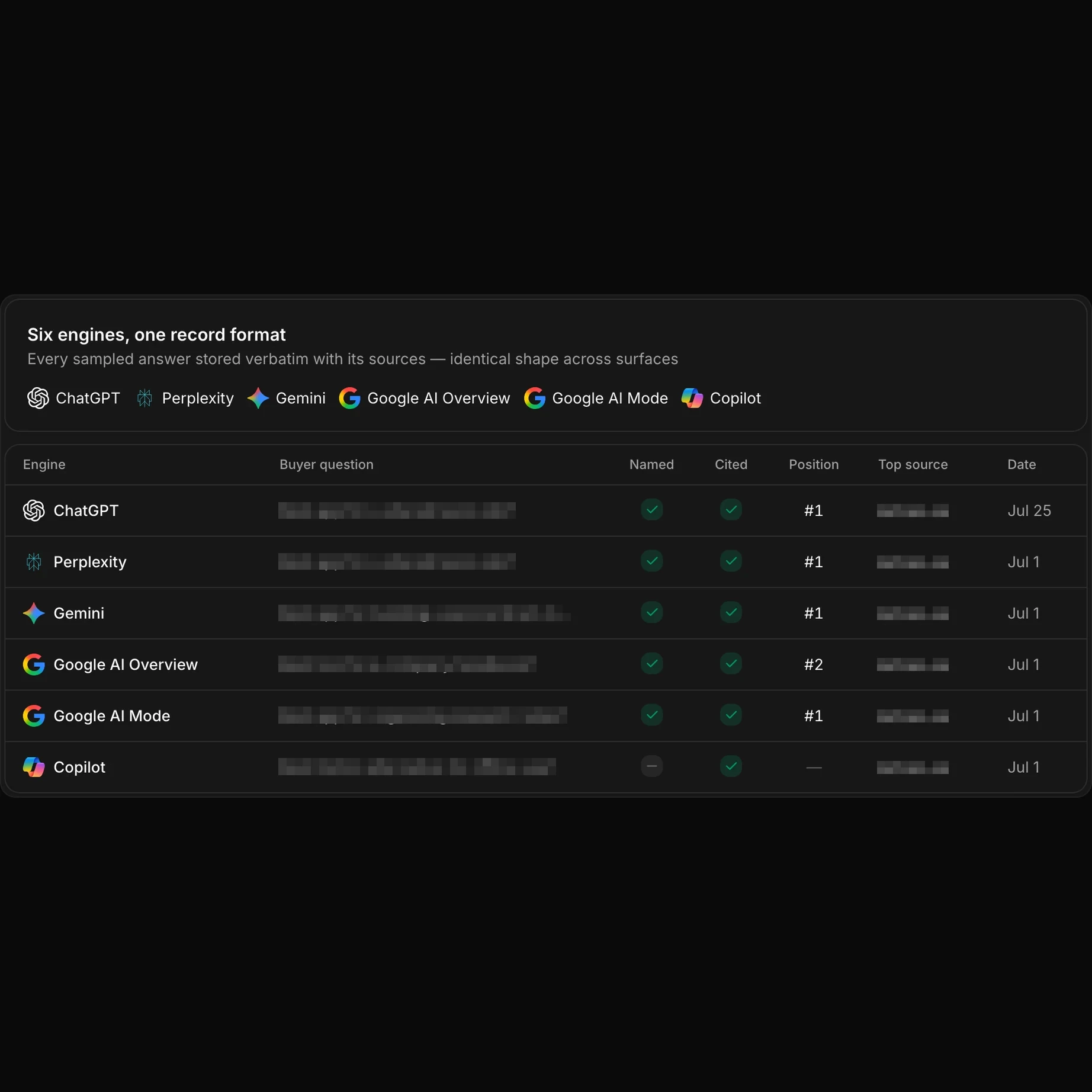
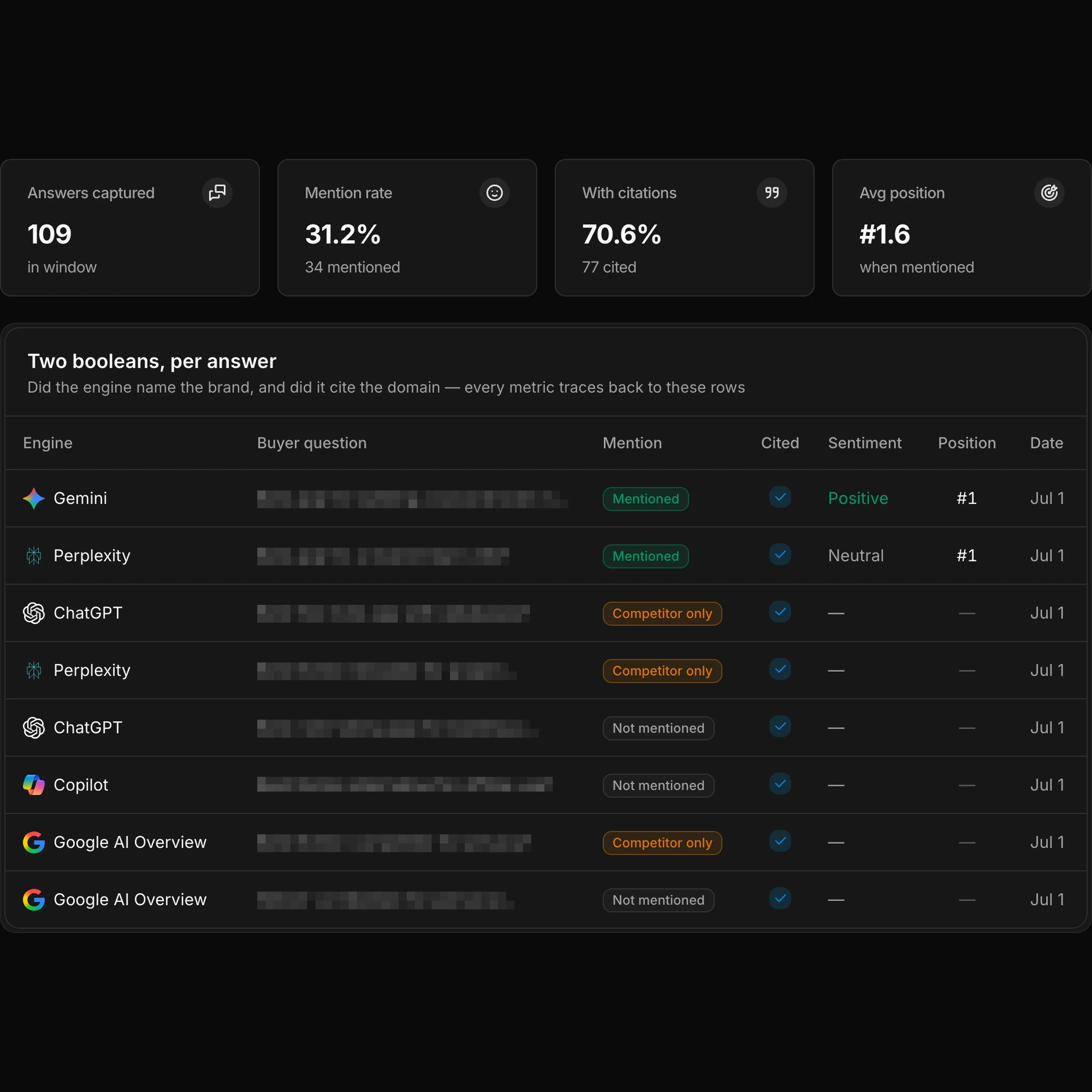
TL;DR: How to track brand mentions in AI search comes down to two facts you read off every single answer - is the brand's name written into the text a reader sees, and does the brand's domain sit in the source list underneath it. Share and coverage figures are arithmetic on those two; position and sentiment are judgements we leave out of a client report on purpose. The working method is one frozen prompt set, run three times per prompt per engine, logged out, from a stated region, with the verbatim answer stored behind every number. The six engines show you those two facts in six different places, and one of them - Google AI Overviews - needs a third boolean in front of the other two. This page is the cross-engine parent; the six engine guides linked below carry the per-engine detail.
Agencies rarely lose a client meeting over which engine they tracked. They lose it when the client asks how many times the prompt was run and the honest answer is "once". A single generative answer is a sample of one from a distribution that moves for reasons that have nothing to do with the client's website. Everything in this guide exists to turn that sample of one into something you can put a name on.
This page owns the cross-engine method. Each engine has its own guide, because the two facts sit in different places on each screen: ChatGPT, Perplexity, Gemini, Google AI Overviews, Google AI Mode and Microsoft Copilot. For the definition of the two facts themselves, see mention vs citation. Once an answer has been scored, the next move is set out in our source-gap versus conversion-gap framework.
Why this is not a rank check
A rank check asks where you sit in an ordered list that the engine publishes. What an answer engine returns instead is one synthesised paragraph, sometimes with sources attached, and the order in which brands appear inside that paragraph is a property of the sentence, not of a ranked result set.
This matters because the phrase "position in AI search" is in circulation. Profound's own tracking walkthrough describes an Average Position metric and illustrates it with a tracked brand sitting at 5.1 (tryprofound.com/blog/how-to-track-your-visibility-in-ai-search, accessed 2026-09-11). Order of appearance is a real, readable thing. It is not a rank, it can move when the same prompt is run again, and presenting it as a rank sets up a question you will not be able to answer six weeks later. We do not report position for that reason.
The two facts that do survive a re-read by a sceptical client are these:
- Named. Is the brand's name written into the answer text? Yes or no.
- Cited. Does at least one URL on the brand's domain sit in that answer's source list? Yes or no.
One of those breaks because the engine never learned the brand; the other breaks because the engine learned it somewhere else. Two causes, two remedies — which is exactly why averaging them into one percentage throws away the only actionable part.
What each of the six engines lets you observe
The reading discipline is identical everywhere. What changes is where on the screen each fact lives, and what extra field that engine forces you to record. This is the row-by-row version the engine guides leave implicit, and it is the difference between a method that transfers across engines and six unrelated habits.
| Engine | Where you read named | Where you read cited | Extra field this engine forces |
|---|---|---|---|
| ChatGPT | The answer prose | Source chips, when web search fired; often nothing to read | Whether web search was active, model, and memory/personalisation state |
| Perplexity | The answer prose - not the chip | The numbered Sources list under the answer | Free versus Pro mode, the selected model, first turn or follow-up |
| Gemini | The answer text | Source links when grounded on Search; none at all when model-only | Grounding state - it decides what "not cited" even means |
| Google AI Overviews | The Overview text, if one rendered | The Overview's small set of cited links | A third boolean in front: did an Overview trigger at all |
| Google AI Mode | The answer text | The sources shown for that answer | Turn number, plus a wider sampling window because fan-out drifts |
| Microsoft Copilot | The conversational prose | The numbered footnotes and their source cards | Which Copilot - public web/Edge sidebar, not Microsoft 365 work mode |
Two of these rows are load-bearing and get skipped almost everywhere. Gemini's grounding state decides whether "not cited" means "it cited someone else" or "it retrieved nothing at all" - two opposite situations that need opposite work. The AI Overviews trigger boolean exists because Google shows an Overview only for some queries, so a citation rate calculated over all queries and one calculated over triggered queries are different numbers with the same name. We read seven competing guides on 2026-09-11 - Profound, Siftly, LLM Pulse, Dageno, AthenaHQ, impact.com and Vismore - and not one of them records Gemini's grounding state. On the Overview boolean there is a single exception: AthenaHQ's free-method guide tells you to record, for every query, whether an Overview surfaced at all, and its copyable tracking schema carries an AI answer appeared field (athenahq.ai/blog/free-ai-search-visibility-tracking-methods--tools-for-2026, accessed 2026-09-11). The other six leave it out.
The five-step method for how to track brand mentions in AI search
- Freeze a prompt set of 20-50 buyer questions. Question-shaped, in the client's category, phrased the way a person types. Brand-name lookups flatter everyone and diagnose nothing. Write the date you froze it; changing a prompt starts a new series.
- Fix the run conditions and write them down. Logged out or a clean browser profile, one stated country, one stated device class, and the model or mode you used. These are not trivia - they are the only reason two people get the same reading from the same prompt.
- Run each prompt three times per engine per check. One run is a sample of one. Three is the smallest number that can break a tie. More on why below.
- Score two booleans per answer and store the answer text. Named from the prose, cited from the source list, plus the cited URLs with tracking parameters stripped. The stored text is what makes the number re-openable in month three; a chart is not.
- Compare each client only against that client's earlier runs. An industry band nobody can reproduce is not a baseline. Raise a flag on a prompt only once it has moved further than the run-to-run spread step three already measured for it.
That is the whole method. The work is in holding it steady for six months, not in understanding it.
How many runs per prompt, and how to collapse them
This is the section the pages we read leave out, and it is the one that decides whether a number is defensible.
Run every prompt three times per engine per check, then take the majority, not the mean. Two of three answers naming the brand scores named = yes for that check. Record the split (3/3, 2/3, 1/3, 0/3) in its own column, because a prompt that reads 2/3 one week and 2/3 the next is stable, while a prompt swinging 3/3 to 0/3 is telling you something a single boolean hides.
Three is a convention, not a finding. It is the floor at which a tie can resolve, and the cost of going higher compounds fast: 25 prompts across six engines at three runs is 450 answers per client per check. Say so in the report rather than implying a larger sample.
Of the seven pages we read for this guide, only one states a run count. The Vismore study published on 2026-04-15 ran 50 prompts across five engines with three identical runs each, for 750 responses, collected between 1 and 15 March 2026, with the location given as US English (vismore.ai/blog/track-brand-mentions-ai-search, accessed 2026-09-11). It also shows the limit of the genre: a stated location is not a reproducible IP or VPN setup, the page never says whether the sessions were logged in, it covers five engines rather than six, and the underlying data is described as "available on request" rather than published. Run counts are not exotic in the wider literature either - the Semrush explainer on this topic warns readers off one-off manual checks on the grounds that the same question, asked again and again, returns a different brand list almost every time - a claim it attributes to SparkToro rather than to its own measurement (semrush.com/blog/is-your-brand-visible-in-ai-search-results, published 2026-02-11, accessed 2026-09-11). What none of the seven gets to is the operational rule: how many runs a working check needs, and how to collapse them into one reading.
The other guides we read are quieter still. The impact.com guide names ChatGPT, Gemini and Perplexity, carries no visible publication date on the page (its structured data says 2026-05-19), and states no run count, logged-in state, region or model version; its headline metric, share of model, is defined twice and the two definitions disagree - once as how often a brand is the recommended answer, once as a count of citations across LLMs - so the two facts never become two numbers (impact.com/affiliate/how-to-track-brand-mentions-in-ai-search, accessed 2026-09-11). AthenaHQ's free-method guide is the most careful of the set - it records account state, country, language and device, and tells you to keep conflicting answers as separate rows instead of averaging them away - but its manual workflow covers four platforms, and when two checks disagree it sends you back to the prompt on the next scheduled pass instead of resolving the split inside the current one (athenahq.ai/blog/free-ai-search-visibility-tracking-methods--tools-for-2026, accessed 2026-09-11). Siftly's 791-word engine-by-engine guide, last updated June 2026, asks for repeated sampling of the same prompt but never names a number (siftly.ai, accessed 2026-09-11). LLM Pulse's guide, published 2025-09-23 and last updated 2026-08-10, walks through ChatGPT, Perplexity, AI Overviews and AI Mode by hand, and every instruction to repeat means a different prompt, country or language rather than the same prompt twice (llmpulse.ai, accessed 2026-09-14). Neither gets you to a number you can defend. Dageno's page under the same heading is a 10-tool buying list rather than a method, and does not state a sampling protocol either (dageno.ai/blog/best-tools-for-tracking-brand-mentions-in-ai-search, accessed 2026-09-11).
Repeat runs are the cheapest credibility you can buy, and they are the first thing cut when tracking is done by hand at the end of a Friday.
Reading one answer, end to end
Make it concrete with a worked example - the three runs below are illustrative, not a recorded check. The client is a fictional project-management tool, the prompt is "which project management tool works best for a five-person agency?", and you run it in Perplexity, logged out, US, first turn, three times.
Run one names the client and lists its domain in Sources: named yes, cited yes. Run two names the client but every source resolves to a review directory: named yes, cited no. Run three never says the name, and source four is one of the client's own blog posts: named no, cited yes.
The check scores named = 2/3 → yes, cited = 2/3 → yes. But the split column is where the work order lives. Run two is a source gap: the reader hears the name and clicks through to someone else. Run three is a conversion gap: the content did the job and the brand vanished from the sentence. One merged percentage erases both; two booleans plus a split preserve them. That is the entire argument for this method in one prompt.
Share of voice, if the client asks for one number
Share of voice is arithmetic on the two booleans, not a separate measurement, and it is only readable when the denominator sits next to it. Report two figures, never one: named share is the number of prompts whose answer wrote the brand's name, divided by the prompts in the frozen set that returned an answer at all; cited share is the number whose sources included the brand's domain, over the same denominator. Write the brand set, the prompt set, the engine, the region and the run count beside both figures, because any percentage with a hidden denominator can be moved by editing the prompt list rather than by doing the work. Google AI Overviews forces one more decision: a prompt that never triggered an Overview is not a miss, and dropping it from the denominator changes the number without changing reality. There is no benchmark worth hitting - compare against the same client's previous check and nothing else. AI share of voice carries the short definition.
When to stop doing it by hand
The best ways to track brand mentions in AI search change with roster size, not with ambition. Here is the crossover, stated as arithmetic rather than as a pitch.
| Situation | Answers per check | Do it by hand | Hand it to a platform |
|---|---|---|---|
| One brand, 25 prompts, 3 engines, monthly | 225 | Yes - a long afternoon, once a month | Not yet |
| One brand, 25 prompts, 6 engines, weekly | 450 per week | Borderline - the first skipped week breaks the trend line | Worth pricing |
| Three or more clients, 6 engines, weekly | 1,350+ per week | No | Yes |
| Any roster where a missed re-run costs a retainer | Any | No - the risk is operational, not arithmetic | Yes |
| You need six months of stored answers you can reopen | Any | Only with real discipline about storage | Yes - and ask every vendor what it retains, in writing |
Before you price anything, run the manual version once. It is the only way to know what the software is approximating on your behalf. Our AI visibility checker builds a 25-prompt starting set, then a scoring sheet of 75 rows covering three engines, entirely in your browser — no upload, no score attached.
Where Jincove fits, stated plainly: we run a frozen prompt set across the engines on a schedule with a workspace per client, and every number opens back to the stored answer, its sources and the run metadata. Repeat runs inside a single check are a scoping decision, not a default - a three-run protocol triples the runs of a one-run protocol. Price it before you promise it, and get the engine list written into the scope before you sell a six-engine deliverable. Part of the live collection also runs through a managed AI-scraper provider rather than crawlers we operate ourselves.
Per-engine deep dives
The two booleans are the same everywhere. Everything else - where the sources appear, what the engine hides, what extra field to log - is per engine, and each guide carries the screen-level detail this parent page compresses into one table row.
- How to track brand mentions in ChatGPT - the engine that mostly hides its sources, and how to handle memory contamination.
- Track brand mentions in Perplexity - numbered citations make cited trivially readable and named easy to misread off a chip.
- Track brand mentions in Gemini - grounded on Search versus model-only, and why the distinction rewrites your citation column.
- Track brand mentions in Google AI Overviews - the trigger boolean, and why a screenshot is a first-class artifact on a surface that may not render twice.
- Track brand mentions in Google AI Mode - heavy query fan-out, cluster prompt sets, and a wider sampling window.
- Track brand mentions in Microsoft Copilot - Bing-grounded retrieval, and the difference between web Copilot and Microsoft 365 work mode.
What this method cannot tell you
State these in the first report rather than the last one.
It cannot give you a rank. There is no ordered list to hold a position in, and any number presented as one is either a classic search position for the same query or a proprietary score with no external definition.
It cannot tell you how the brand was described. We score whether the name appeared, not whether the sentence was flattering. Sentiment scoring, hallucination detection and fact-checking the model's prose are not part of this method and not part of our product.
It cannot prove a fix caused a change. You get a before, an after and a timestamped record of what you shipped in between. Engines move on their own - model updates, index refreshes, region, time of day - so the honest claim is "this is what moved", never "our change caused this".
It cannot promise an engine will name anyone. Nobody controls what these models say. This is measurement, not influence, and we do not sell the second thing - so if a proposal you are comparing promises a guaranteed recommendation, ask how it would be verified.
Clean sessions reduce personalisation contamination; they do not remove it. No browser-based method reproduces exactly what a stranger in another country sees.
Questions agencies ask
Is it possible to track brand mentions in AI search at all?
Yes - but how to track brand mentions in AI search means sampling, not querying. No engine hands you a named-versus-cited readout; the nearest first-party reporting comes from Google and Microsoft, and both stop short. Google's documentation puts sites appearing in AI Overviews and AI Mode inside ordinary Search Console performance data, in the same "web" search type as blue links (Google's AI-features documentation, accessed 2026-09-14). Microsoft's AI Performance preview in Bing Webmaster Tools counts citations across Copilot and Bing's AI summaries together (blogs.bing.com/webmaster, announced 2026-02-10, accessed 2026-09-14). Both cover your own property only, and neither names a competitor; for ChatGPT, Perplexity and Gemini we found nothing equivalent open to an ordinary site owner. So you sample: a fixed prompt set, fixed conditions, two booleans, the text stored, diffed against the client's own history - a defensible trend for a defined slice of buyer questions, not a population measurement.
What are the best ways to track brand mentions in AI search on a small budget?
Manually, for one brand, and properly. Twenty-five prompts, three engines, three runs each, once a month, in a spreadsheet with the answer text pasted in - that is 225 answers and roughly one afternoon, and it beats a cheap tool that samples once and shows you a percentage. Spend the money instead on the thing you cannot do by hand: unbroken frequency across a roster. For the starting prompt set and a scoring sheet, the free AI visibility checker generates both in the browser. Its sheet is one row per prompt per engine - 75 rows - so duplicate the block twice if you follow the three-run rule above.
Why do two tools report different numbers for the same brand?
Because the two samples are not the same sample. Six things move independently: which prompts were asked, which region and login state they were asked from, how many times each one ran, which engines were in scope, what counts as a mention - a bare occurrence of the brand string for one vendor, only an actionable recommendation for the next - and what happens to a prompt that returned no Overview at all, which one tool scores as a miss and another removes from the denominator. Two honest tools can report different brand mentions in AI search results without either being wrong. Never mix two vendors' figures in one client chart, because the reader will read the gap as movement. Pick one method, write the sampling frame down next to the number, and compare only against your own history.
How often should the prompt set be re-run?
Weekly for most rosters, without gaps, and monthly only if the category moves slowly. Daily mostly buys variance rather than signal, because generative answers move day to day for causes unrelated to the brand. The cadence matters less than the consistency: an unbroken weekly line is a trend, and a line with two missing weeks is an anecdote a client can dismiss. Whatever cadence you pick, keep the prompt set frozen between runs - editing a prompt resets its history. The usual arrangement is a frozen core set that carries the trend and a separate exploratory set for new questions, promoted into the core set only at a stated date. Your cadence and the cadence a plan runs on are two different decisions.
Does this cover every AI engine?
No. This method covers six: ChatGPT, Perplexity, Gemini, Google AI Overviews, Google AI Mode and Microsoft Copilot. It does not cover the Chinese-market engines, and it does not cover assistants embedded inside products you cannot reach from a browser - Microsoft 365 Copilot in work mode grounds partly on a tenant's own documents, which is a different surface from the public web Copilot this method reads. The reading discipline transfers to any engine that shows an answer and, sometimes, its sources; the coverage question is whether you can reach it reproducibly. If a client's buyers live somewhere we do not measure, say so before the first report rather than after it.
See it on one of your own clients
Run the manual version once before you buy anything that automates it. Ask us for a free, human-run audit: one brand, one URL and one email is all it takes, and a person - not a pipeline - puts your buyers' questions to ChatGPT, Perplexity and Gemini, three of the six engines rather than the full set. Inside two working days you get each answer verbatim, every source it cited, and the named-versus-cited call on each one. Nothing to pay and no account to open. If it earns its place on one client, the paid plans run the same method across the wider engine set.
Engine behaviour and competitor pages described on this page were checked on 2026-09-11. The two first-party engine reports - Google's AI-features documentation and the Bing Webmaster Tools AI Performance preview - and the LLM Pulse guide were checked on 2026-09-14; no first-party equivalent for ChatGPT, Perplexity or Gemini was found on that date.
Related blogs
Related Post
Expand your knowledge with these hand-picked posts.
How to Track Brand Mentions in ChatGPT in 2026: The Agency Method
ChatGPT has no Search Console - no impressions, no analytics, no export. Here is the method agencies use to track brand mentions across ChatGPT and the other answer engines without trusting a black-box score, and why "citations" and "mentions" are two different numbers.
Gan Liu
Best AI Visibility Tools for Agencies in 2026: An Honest Shortlist
Most "best GEO tool" roundups rank on engine count. Agencies buy on a different axis - client roster, white-label, and evidence you can hand a client. Here is the honest shortlist, what each tool is actually best at, and the three questions that decide it.
Gan Liu
How to Track Brand Mentions in Perplexity in 2026: The Agency Method
Perplexity shows numbered citations and a Sources list under every answer. The agency method for reading brand mention vs citation off it - no black-box score.
Gan Liu
See what AI says. Then fix it.
Send one brand. Get the answers, the sources, and the first gaps worth fixing.
No card. No call. No catch. Reply in 2 business days.