Peec AI Alternatives: 8 Compared for Agencies
Eight Peec AI alternatives weighed for an agency roster, plus what Peec itself charges. Every price is linked to its source page and dated, or else MISSING.

TL;DR: Most pages about Peec AI alternatives cannot tell you what Peec itself costs, so start with that: $95, $245 and $495 a month on its three brand tiers — €85, €205 and €425 if it bills you in euros — and $245, $495 and $795 on the three priced tiers of its separate agency page. That is a single settled answer, and it took us three attempts to get it. The source is peec.ai/pricing itself, in two places: the figures ship as constants inside the page's own JavaScript, and they render on screen for anyone who opens it in a browser. We read both on 13 September 2026. A plain automated request receives neither, which is why our first two passes came back empty; and they explain most of the apparent disagreement in the coverage — three of those five pages are right, in different currencies and different billing terms. So this page does the dull part first: every number below carries its source page and the date we read it, and where we genuinely could not read one we wrote MISSING. Eight options follow, in no particular order.
Two disclosures, and they belong at the top rather than in a footer. Row seven of nine is our own product: Jincove is an AI visibility monitor sold to agency buyers, so the eight products beside it are rivals, and our row carries its own paragraph on who should not buy us. There is no partnership, reseller relationship or endorsement between Jincove and Peec AI.
Two sibling pages carry the jobs this one skips: the full category shortlist for agency buyers for choosing from a standing start, and the twelve questions to ask any AI visibility provider for the buying conversation itself. This page answers one narrower question: you are on Peec, or were about to be, and you want to know who else does this job, how each one meters it, and what you still hold once the subscription stops.
The Peec AI alternatives at a glance
Peec stays in the table as the baseline rather than as a candidate. Every cell below is what the vendor's own page showed us — not a quote, not a negotiated rate, and not copied from another comparison article. Most were read on 11 September 2026; three rows carry a later date because we had read them wrong the first time and went back with the vendor's own scripts and a browser. Each says so where it sits.
| Product | Billing unit | Published entry price, with the date we read it | Engines the page lists | How it handles a roster |
|---|---|---|---|---|
| Peec AI (baseline) | Fixed brand tiers; agency tiers metered in credits | Brand tiers Starter $95/mo, Pro $245, Advanced $495 (€85 / €205 / €425); agency tiers Essential $245, Growth $495, Scale $795; Enterprise and Comprehensive custom. Read 13 September 2026 in a browser and in the page's own scripts — a plain fetch gets no figure at all | 6 available on self-serve, 3 active at a time; up to 13 on Enterprise and on the top two agency tiers | Agency tiers carry 3 / 10 / 25 / unlimited client projects, unlimited team and client seats, pitch projects |
| Profound | Unique prompts per plan | Default billing is monthly — Starter $99/mo and Growth $399/mo, falling to $82.50 and $332.50 on the yearly switch; the agencies view adds Agency Growth at $99/mo with client workspaces at $399/mo each; Enterprise reads Custom | ChatGPT only on Starter; 3 on Growth; up to 9 on Enterprise | An agency view on the same pricing page publishes Agency Growth: $99/mo base, 5 agency seats, +$399/mo per client workspace, +$199/mo per 5 pitch workspaces |
| Scrunch AI | Unique prompts per plan, priced separately for brands and for agencies | One pricing page, two plan sets behind a toggle: Core $250/mo for brands, Agency Core $500/mo for agencies, both on a seven-day free trial; Enterprise custom in either view. Agencies view read 13 September 2026 | 4 on either Core view — ChatGPT, Perplexity, Google AI Overviews and Copilot — rising to 9 on Enterprise once Claude, Gemini, Meta AI, Google AI Mode and Grok come in | 1 brand workspace against 5 user licences on Core; on Agency Core that becomes 3 brand workspaces, licences off the meter, and 3 pitch workspaces the grid qualifies as Partner Only |
| AthenaHQ | Credits — one AI response spends one credit | $295/mo buys Starter's 3,600 credits, or 17% under that annually; above it Enterprise reads Custom, below it a free tier carrying $25 of credit | Free tier lists 5; Starter lists 11 and says more are available on request | Unlimited members; brands per plan not stated. API access is a paid add-on on Starter |
| LLM Pulse | Tracked prompts and projects per plan | Every tier carries a figure, the agency-grade Partner ones included: Starter €49/mo, Growth €99, Scale €299, Scale+ €599, Scale++ €1,199, Partner €1,499, Partner+ €1,999, Partner++ €3,799. Those are month-to-month on weekly tracking; the grid opens on annual, which bills ten months for twelve, and daily tracking costs more on every tier. Partner rows and the billing default read 13 September 2026 | 5 models on every tier: ChatGPT, Perplexity, Gemini, Google AI Mode, AI Overviews | Projects 1 / 2 / 5 / 10 / 15, rising to 25–35 on Partner tiers; one extra project is €50/mo and an extra model starts at €10/mo |
| Otterly.AI | Prompts per plan, with add-on packages | Lite $29/mo (15 prompts), Standard $189/mo (100), Premium $489/mo (400) — carried in the pricing page's own meta description and product schema; the plan cards themselves did not render to our fetch | Its agency page names 6: Google AI Overviews, ChatGPT, Perplexity, Google AI Mode, Gemini, Copilot | Agency page publishes workspace management, a Looker Studio connector and unlimited brand reports |
| SE Ranking | An SEO platform subscription, with a separate AI Search add-on on top | MISSING in USD — served to our IP in yen: Core ¥21,819/mo month-to-month or ¥17,455 annual, Growth ¥47,190 or ¥37,752, AI Search add-on ¥13,098 or ¥10,478 | 5 LLMs on both published platform tiers | Core carries 10 projects and 1 manager seat, Growth 30 and 3; white label is a separate Agency Pack at +¥10,609/mo, annual billing only |
| Ahrefs Brand Radar | Tracked AI prompts inside an SEO suite | MISSING in USD — served in yen: Lite ¥19,900, Standard ¥38,400, Advanced ¥68,900; standalone Brand Radar AI from ¥30,600 | Seven, by two routes on the same page (read 2026-09-14): the comparison table's Platforms row renders as a five-button selector labelled ChatGPT, Perplexity, AI Overviews, Copilot and Claude, and the page's own plan data prices five single-engine index add-ons — Google AI Overviews, ChatGPT, Gemini, Perplexity and Grok — at ¥30,600/mo each. The selector is one control repeated per plan column, so which tier gets which platform is MISSING | Tracked AI prompts of 5, 10 and 20 by tier, on a row whose per-project qualifier is absent — unlike the competitors row above it; extra checks come in packages |
| Jincove (ours) | Per engagement | Scoped per engagement; free sample audit first | Six named engines — ChatGPT, Perplexity, Gemini, Google AI Overviews, Google AI Mode, Copilot. The free sample audit covers three | A workspace per client. White label is labelled coming soon and has not shipped |
Sources, in order: peec.ai/pricing and peec.ai/pricing-agencies; tryprofound.com/pricing and Profound's agency post; scrunch.com/pricing — both views of it — and scrunch.com/agencies; AthenaHQ's self-serve plans; the LLM Pulse tier ladder; Otterly.AI's plan cards plus its agency page; SE Ranking's subscription page; and the Ahrefs plan table. Read 11 September 2026, except four lines read 13 September 2026: both Peec pricing pages, the Scrunch agencies view, the Profound agency post and the LLM Pulse tier ladder.
What Peec AI already does well, and who should stay put
Half the pages we read on this query skip this part, which is the part that decides whether you should switch at all.
Seats are not a tax. Every Peec tier we read lists unlimited users, and the agency tiers add unlimited client seats on top. If six account managers each need a login, that one line can outweigh a price difference. Several products in the table above meter seats instead: Scrunch caps its brand tier at five user licences and prices the sixth in its own FAQ, at $25 a month per user or $75 for five, while leaving its agency tier uncapped; Ahrefs includes a single user on Lite, Standard and Advanced alike, charging ¥6,160 to ¥12,320 a month for each extra one.
The pitch machinery is real, not a discount. Peec's agency page publishes free pitch projects — 3 on Essential, 5 on Growth, 7 on Scale, 10 on Comprehensive — carrying 25, 50 and 75 prompts on the three priced tiers and unlimited on Comprehensive, each on a seven-day window and each convertible to a paid client project if the prospect signs. Most products in this set offer nothing comparable.
Daily is the default, not an upgrade, on every self-serve tier we read; Enterprise on the brand page and the top two agency tiers list daily or weekly instead.
The metric vocabulary is already the right shape. Peec's pages keep citation share and source-level gap analysis in separate rows from brand visibility rather than blending them into one index. That distinction — a mention and a citation are two different numbers — is the one most tools here still collapse.
So: if you run a small roster, need every colleague logged in, and the three active models you get cover the surfaces your clients' buyers actually use, staying on Peec is defensible and this page is not trying to talk you out of it. The rest is for the cases where it is not.
Nobody quoting a Peec AI price shows where they got it
Here is the finding that justified writing this page. We opened the five article-style pages we could read on the day — G2 and Capterra rank for this query too, but a directory listing is a different kind of page, and three further articles returned nothing to us — and read what each says Peec costs. Between them they give three Pro prices, two currencies, five answers to the engine question and two add-on rates, and not one shows the page it came from or the day it was read. The bottom row is Peec's own page, which is the row that makes the rest of the table legible.
| Page (figures read for this piece; each page's own stamp is in the next column) | Its own date | Peec Starter | Peec Pro | Base engines it claims | Extra engine | Source URL shown? |
|---|---|---|---|---|---|---|
| blog.timsoulo.com | 4 Mar 2026 | not stated | €199/mo, 100 prompts, 9,000 AI answers | 4 | Claude, Gemini and AI Mode described as Enterprise | No |
| geoptie.com | updated 16 Jul 2026 | €89/mo in one paragraph, €85/mo elsewhere on the same page | €205/mo (Advanced €425) | Says six engines in one place and three of the seven in another | €70/mo on Pro, €140/mo on Advanced | No |
| radarkit.ai | updated 28 Jul 2026 | €89/mo | not stated | Names ChatGPT, Perplexity, Claude, Gemini | not stated | No |
| writesonic.com | verified Jul 2026, updated 6 Aug 2026 | $95/mo | $245/mo (Advanced $495) | 3 selected | $35 Starter / $85 Pro / $165 Advanced | No — one page-level sentence, not per figure |
| blog.hubspot.com | self-dated 3 Sep 2026 | $95/mo | $245/mo (Advanced $495) | Claims up to 10 AI models at once, then lists 8 | not mentioned; states a 15% annual discount | No |
| peec.ai/pricing (first party) | read 13 Sep 2026 | $95/mo, or €85 | $245/mo, or €205 (Advanced $495 / €425) | 6 available, 3 active; 13 on Enterprise | $35 / $85 / $165 monthly, or $30 / $70 / $140 on annual terms (€30 / €70 / €140 and €25 / €55 / €115) | — (it is the source) |
Now put the first-party row against the five above it, and the picture inverts. Three of the five are right. Writesonic's and HubSpot's $95 / $245 / $495 are Peec's own dollar figures to the digit. Geoptie's €85 / €205 / €425 are Peec's own euro figures to the digit. Writesonic's extra-engine prices, $35 / $85 / $165, are Peec's monthly dollar add-on rates; geoptie's €70 and €140 are the monthly euro rates for the same two tiers. What looked like five authors contradicting each other is mostly two currency columns of one ladder, quoted without saying which.
The add-on block is where this gets genuinely nasty, and it is worth a sentence on its own. Peec's monthly euro add-on rates are €30 / €70 / €140, and its annual dollar rates are $30 / $70 / $140 — the same three digits. At plan level it repeats on Pro, which is €205 a month month-to-month and $205 a month on annual terms — the same number, two different deals. A figure lifted from any of these pages without its currency and its billing term is not a figure.
Two figures survive that explanation and we cannot place them: the €89 entry price in geoptie and radarkit, and the €199 Pro in the March page. Neither appears anywhere in Peec's current constants. Those pages are two and six months old, so a reprice is the obvious guess, and a guess is all it is — nobody wrote down a date next to the number, which is the only thing that would settle it.
The engine column is the part that does not resolve. Three of seven, four, six, up to ten, eight — five answers, and the first-party page says six available with three active at once, thirteen on Enterprise. There the coverage is simply wrong rather than under-specified, and no currency explains it.
So the honest version of this finding is narrower than nobody agrees, and more useful. Peec publishes its prices. It publishes them in a way that a plain automated request cannot see — the page is a Framer build that assembles the plan cards in the browser, so curl gets a page with the funding round on it and no plan price anywhere — and every page above republished a figure from it without recording which currency, which billing term, or which day. Get any of those three wrong and you quote a client a number that is off by the annual discount, or by the whole dollar-to-euro spread, and nothing on the page you copied it from tells you so.
We made this exact mistake three times while writing this page, which is the best argument we can offer for the method. Three vendors here publish prices our own capture came back without, by three different mechanisms, and each one first went into a draft as something the vendor had declined to publish. For two of the three, the figure is served by the page's script layer rather than the HTML a plain request receives. The third was on screen all along, and we walked past it.
Scrunch hides half its plan grid behind a For brands / For agencies switch that only exists once JavaScript runs — so a fetch, our crawler, and the web archive all return the brands half and nothing else. A draft of the row said the product had one self-serve tier and no published agency price. It has two, and the agency one is $500 a month. LLM Pulse prints every tier's price into the page it serves, but puts the euro amount in a button's accessibility label and the on-screen amount in a node our text extractor walks past, so our capture came back with all nine plan cards blank; a draft reported three of those blanks as tiers the vendor declined to price. Eight of the nine carry a figure. Peec is a Framer site that assembles its plan cards in the browser, so the served HTML contains no plan price at all — and a draft of this page put MISSING in the most important cell in the table and built a headline on it. The prices were in the page's own JavaScript the whole time, and on screen for anyone who opened it.
One rule covers all three, and it now governs every cell in this article: an empty price in our capture is evidence about our crawler and never about the vendor. Before any row here says a figure is not published, we check the served HTML including its accessibility attributes, pull every script bundle the page loads rather than the first one, look for a toggle and record which side it opens on, and then open the page in a browser. Only when all of that comes back empty does a cell say MISSING, and it says which route we tried. Three rows in this table changed after we started doing that, all three in the vendor's favour.
Including us. Four already-published pages on this site repeat a Peec price range with no source URL behind it, inherited from an internal comparison file captured in August 2026. As it happens those numbers are close to correct, which is exactly the problem — nobody reading them, us included, could have known that. They are on our correction list and this page supersedes them. A competitor number on jincove.com with no page and no date attached to it deserves the same treatment as everyone else's: hearsay that happened to be right.
What Peec's own pages publish, beyond the sticker
The full price ladder is above. Here is the rest of what those two pages carry, some of which decides more than the sticker does.
The whole ladder, in one place. Brand tiers are $95, $245 and $495 a month, or $80, $205 and $420 on annual terms; in euros, €85 / €205 / €425 and €70 / €180 / €360. Agency tiers start at $245 a month for 10,000 credits and run $495 for 25,000 and $795 for 65,000, or $205, $420 and $675 on annual terms, with a slider on each card that buys more credits inside the same tier — 15,000 for $345, 35,000 for $695, 85,000 for $1,195. Enterprise on the brand page and Comprehensive on the agency page are both quotes. Watch the billing control: it sits on each card rather than at the top of the page, the plan cards open on Monthly and the add-on cards open on Annual, so two figures side by side on the same screen are not on the same term. The comparison table further down the agency page does not follow its own cards either. On the browser load we recorded on 13 September 2026 the three agency tiers read $205, $420 and $675 in that table — the annual rates — while the cards above them read $245, $495 and $795 and said Monthly. The middle row is what settles which is which: $420 is that tier's annual rate, where its monthly euro price is €425. The brand page's table did not do this; it showed the same $95, $245 and $495 as its cards. One browser load is one browser load, so check the row you are about to copy before it goes into a quote.
The brand tiers, from the comparison grid. Starter: 50 prompts, 1 project, 1 country. Pro: 150 prompts, 2 projects, 3 countries. Advanced: 350 prompts, 5 projects, multi-country and a Looker Studio integration. All three list unlimited users, daily tracking, and the same six available models — ChatGPT, Google AI Mode, Google AI Overviews, Microsoft Copilot, Perplexity, Gemini — of which three can be active at once. Enterprise lifts the cap to 13 by adding the seven the vendor spells Claude Sonnet 4, GPT 5 Search, Grok, Deepseek, Qwen, Mistral and Meta Spark, through APIs, plus SSO and API access.
The unit, which the page defines for you. A "monthly AI answers" row is published as tracked prompts × active models × frequency, and the values confirm it: 50 × 3 × 30 = 4,500 on Starter, 150 × 3 × 30 = 13,500 on Pro, 350 × 3 × 30 = 31,500 on Advanced.
The agency credit resolves to one answer. Essential carries 10,000 credits a month, Growth 25,000, Scale 65,000, Comprehensive unlimited on annual terms; the page's own example configuration turns those into 111, 277 and 722 prompts. Against the formula above, 111 prompts × 3 models × 30 days is 9,990 — the 10,000-credit tier. Growth and Scale check out the same way. That conversion is ours: the page prints the credit allowance and the example configuration, and the division above turns one into the other in about ninety seconds.
And the credit is not what you think a credit is. The agency FAQ states plainly that "Credits are allocation slots, not a monthly budget" — no reset, no expiry, because they describe a tracking rate rather than a pot of fuel. If you have been modelling Peec's agency tiers as pay-as-you-go, that is the wrong model, and it changes every roster calculation below.
Client projects, from the agency grid. 3 on Essential, 10 on Growth, 25 on Scale, unlimited on Comprehensive — consistent with the tier descriptions on the same page, which size Growth for 3–10 clients and Scale for 11–25 or more. Team and client seats are unlimited on all four. Scale and Comprehensive carry the 13-model list; Essential and Growth carry six.
White label, precisely. The agency page headline does say white-label reporting. The documented route we found is a published MCP workflow — pull the data through Peec's MCP server, then build the branded report in an external tool. That is a real capability and it is not a logo-and-domain toggle inside the product. Worth knowing which one you are buying; the distinction applies to most of this table, and we covered it in what white-label GEO reporting actually involves.
Still MISSING after all that: the trial length, although a trial link exists on the agency page; and a published data retention period. Both of those we looked for by every route that produced the prices — served HTML, every script bundle the pages load, and the rendered page in a browser — and neither is there.
How we picked these Peec AI alternatives, and where we are biased
The rubric is written out in full below, because the useful part of a rubric is that it tells you what got excluded and on what grounds.
- It has to answer the same question Peec answers — output-side measurement of what answer engines say about a brand. Content-generation suites and ontology or RAG tooling solve different problems and are not substitutes, however often they appear on lists like this one.
- It has to hold up across a client list, not one brand. Billing that reads cheap for a single site often stops being cheap at client four, so the lines we weighed hardest are project caps, workspace caps, seat metering and whether a quota pools.
- Every figure here was read by us, on the page that publishes it, on the date the line gives — 11 September 2026 unless it says otherwise. Nothing is lifted from another comparison article. A cell says MISSING only after the served HTML, every script bundle the page loads, and the page rendered in a browser all came back without it, and the cell says which of those we tried.
- Ordering is not ranking. The table is ordered by nothing, because nobody can rank these products on accuracy — see further down.
Who we left out. Platforms whose only route to a number is a sales call, because a retainer has to be planned against a figure you can already read; rank-tracking suites that bolted on an AI tab without saying what they sample; and any product whose sole public footprint was somebody else's comparison page.
Where we are biased. One of these nine rows is our own product, and we did not put it first. The fix for a vendor-written comparison was never a neutrality claim; it is putting every source in reach, so an afternoon with the same URLs can catch us out.
Who Jincove does not fit. A brand team with one website will pay for per-client machinery it never opens. Anyone shopping for content written, rewritten or scored for sentiment is in the wrong aisle, because we do none of it. Anyone who needs a single headline visibility number for slide three will not get one: what we hand back is evidence rather than a score, by design. Client-logo dashboards are labelled coming soon and have not shipped, so a logo requirement this quarter should be bought elsewhere. The free way in is a hand-run sample audit across ChatGPT, Perplexity and Gemini, not a self-serve trial. And we publish no retention period.
The eight alternatives, one by one
Profound. The most established analytics product here, and the clearest example of engine gating. Starter lists at $99 a month, month-to-month, and watches ChatGPT and nothing else; Growth is $399 for ChatGPT, Perplexity and Google AI Overviews across 100 unique prompts. Paying yearly takes those two figures to $82.50 and $332.50. The switch that does it is an offer sitting next to the price, not a label on it, and mistaking the two is where most of the coverage of Profound goes wrong. The nine-engine list sits on the Enterprise line, whose card prints Custom, with Tailored packages beneath it (read 2026-09-14). Multi-client work is not: a second view on the same pricing page publishes Agency Growth at $99 a month for the shell, $399 for each client workspace, $199 for every five pitch workspaces, and five agency seats. Those add-on rates are also written out in plain prose in Profound's own post for agencies, so this half of the bill can be modelled without a sales call — which is more than most of this table allows. Both self-serve tiers carry monthly agent credits for content work — real delivery that monitoring-only tools, ours included, do not provide. Not for you if your clients live on Gemini, Google AI Mode or Copilot, because on the published tiers those are absent.
Scrunch AI. Two self-serve tiers, priced separately for brands and for agencies, and the agency one is the easiest published figure to miss in this entire table. A switch at the top of its pricing page reads For brands / For agencies, and those are not two sections of one page — they are two plan sets, only one of which exists in the HTML a plain request receives. Fetch scrunch.com/pricing without running its JavaScript and you get the brands half and nothing else: Core at $250 a month, one brand workspace, five user licences, 125 unique prompts, five site audits a month, four engines — Copilot, Google AI Overviews, Perplexity and ChatGPT. Archived copies of the page behave the same way, which is why an earlier read of ours and a later one did not agree. Four of the five pages in the contradiction table above cover Scrunch: three quote the $250 brands figure and the fourth gives a $99–300 range. The agency figure — Agency Core at $500 a month — is in the paragraph you are reading and in the table above it; one of those four files Scrunch under agencies and then sends agency buyers to Enterprise. Flip the toggle in a browser and a second set appears: Agency Core at $500 a month, same seven-day free trial, with the workspace ceiling raised to three brands plus three pitch environments, the licence count taken off its meter entirely, 250 unique prompts, and site audits counted per brand rather than per account. Enterprise stays a quote in either view, and its engine list runs to nine once Grok, Meta AI, Claude, Gemini and Google AI Mode are added. The comparison grid under the cards moves with the toggle too: Looker Studio, MCP and CLI are ticked on Agency Core and absent on the brands Core. Read that grid before you sign, though, because two of its lines carry a Partner Only qualifier the plan card leaves off — the query API, and the three pitch workspaces themselves. A separate agencies page sells the same story in prose — multi-client workspaces, prospecting environments, white-labelled output, a referral commission of up to 20 per cent — and carries no figure at all. Not for you if your roster runs past three brands and you want a published rate for the fourth: the agencies view prices three workspaces and stops there. Whichever view you were quoted on, screenshot it.
AthenaHQ. The cleanest unit definition of anyone here — one credit equals one AI response, stated on the page rather than derived. Starter is $295 a month — 17 per cent less on annual terms — for 3,600 credits, with unlimited members, CSV export and eleven named models including Claude, Grok, DeepSeek and Mistral. A genuinely free tier carries a $25 credit worth 300 credits across five engines, enough to sanity-check a pitch. Not for you if you need API access included — a paid add-on on Starter, priced contact-us — or need to know how many brands a Starter plan covers, which the page does not say.
LLM Pulse. The most transparent pricing page in this set and the closest structural match to Peec for a euro-billing agency: eight tiers, every one of them carrying a number, with only Enterprise held back for a conversation. Starter €49, Growth €99, Scale €299, Scale+ €599, Scale++ €1,199, then Partner €1,499, Partner+ €1,999 and Partner++ €3,799. The last five sit behind a See Scale+, Scale++ and Partner plans link that is closed when the page loads, so a reader who never clicks it sees three tiers and an Enterprise quote. Two qualifiers before you take any of the eight figures into a quote. Those are the month-to-month rates on weekly tracking, while the page opens on annual, which bills ten months for twelve, and daily tracking is sold as a separate and higher price on every rung. And the euro amounts are the fixed ones: the page lists in EUR and converts into ten other currencies at rates it says it refreshes daily, which is why its Growth and Scale rows read $122 and $366 to us on 11 September 2026 and $121 and $364 on 13 September. Prompts run 50 / 150 / 450 / 1,200 / 2,400 and then 3,600 / 5,000 / 10,000 across the three Partner tiers; projects run 1 / 2 / 5 / 10 / 15 and then 25 / 30 / 35. Add-ons are published too: €50 a month for one more project, €100 for 100 more prompts, from €10 for an extra model. Five models are included on every tier. White label is real here, and the page names three grades of it: a branded subdomain the vendor still hosts, the platform moved onto a domain of yours with its name taken off, or an embed that lives inside a client portal. All three are bundled into the Partner tiers, alongside per-client roles and branded PDF reports. Not for you if you want white label you can cross-check against the rest of the page: the only plan card whose feature list names it is Enterprise, which is quote-only, and the three Partner tiers the agency section says carry it sit outside both of this page's own checking tables — the feature comparison grid runs Starter to Scale and then jumps to Enterprise, and the currency conversion table ends at Scale++.
Otterly.AI. The name that comes up most when European agencies discuss cheap multi-client monitoring. Its agency page publishes workspace management, a Looker Studio connector, unlimited brand reports, six named surfaces and a partner directory listing — all of which we read on that page on the day, though the method behind each one is not published anywhere we could find. The plan cards on the pricing page did not render to our fetch on 11 September 2026, but the page's own meta description and product schema carry all three tiers: Lite $29 at 15 prompts, Standard $189 at 100, Premium $489 at 400. Add-on copy that did load says extra AI engines sell as fixed packages up to 1,000 prompts, and that a Standard plan can absorb only 300 extra prompts before it turns into a Premium plan. Not for you if you need the per-tier detail sitting behind those three numbers: the cards that carry it render client-side and the site turns plain automated requests away, so open it in a browser and screenshot what you are quoted.
SE Ranking. Not a standalone product but an AI Search add-on layered onto an SEO platform, which suits an agency already paying one invoice and unwilling to add a second. Platform plans carry the GEO limits directly: 100 tracked AI prompts a day on Core across 10 projects and one manager seat, 250 a day on Growth across 30 projects and three seats, five LLMs on both. Check the billing term before you quote any of it — the headline ¥17,455 and ¥37,752 are annual rates, month-to-month is ¥21,819 and ¥47,190, and the AI Search add-on is ¥10,478 annual against ¥13,098 monthly. White label lives in a third place again, an Agency Pack at ¥10,609 a month, annual billing only. Not for you if you need a USD figure from a public page — every number rendered to our IP in yen, so the dollar price is MISSING.
Ahrefs Brand Radar. The product sitting at number one on the oldest page in our contradiction table, which happens to be written by Ahrefs' own CMO — so it belongs here even though it is a feature inside an SEO suite rather than a standalone tool. Read the limit twice: tracked AI prompts are 5 on Lite, 10 on Standard, 20 on Advanced, and that row carries no per-project qualifier, unlike the competitors row above it, so we read it as account-wide. A check, in the page's own counting, is a single prompt run on a single platform in a single location. Extra checks sell in packages of 2,500, 7,000 and 25,000, at ¥7,700, ¥15,420 and ¥38,500 a month, which works out at ¥3.08 a check falling to ¥1.54 as the package grows. That per-unit figure is ours rather than theirs: it is the division, and the two numbers it runs on are in the sentence before it. Not for you if you run more than about three clients, since twenty account-wide prompts does not cover one brand properly. USD price MISSING, same yen localisation.
Jincove. Ours — read the paragraph above on who should not buy us before this one. Work is scoped per engagement and starts with a free sample audit. Paid work covers all six engines. Every run stores the verbatim answer, the cited URLs with UTM parameters stripped, and provider metadata.
The column these comparisons never include: what gets stored
Feature comparison is what a roundup on this query does, this one included. The question this section adds is what you still hold once you stop paying. Peec sharpens the point better than any of them: its agency FAQ says the credits are allocation slots rather than a budget, which means what you are buying is a tracking rate, and what you keep is whatever the product wrote down while that rate was running. Nobody can re-run last quarter — put the same question to an engine tomorrow and the wording moves — so the stored answer is the one object in this stack that survives a renewal argument.
| Product | Named and cited kept apart? | Export the page describes | Retention period on the page |
|---|---|---|---|
| Peec AI | Yes — citation share, source classification and gap analysis are separate rows from brand visibility | Custom CSV exports; API and MCP on the higher tiers | MISSING |
| Profound | Lists visibility, citations and sentiment together | CSV and JSON; the plan grid carries a data row reading "All time" | The only page here with anything in this column — confirm what it covers in writing |
| Scrunch AI | Not stated; one combined citations and sources row | Looker Studio, MCP and CLI are ticked on Agency Core and absent on the brands Core; the query API reads Partner Only on Agency Core | MISSING |
| AthenaHQ | One combined "citation intelligence" line | Starter carries CSV data export; the API is a separate purchase | MISSING |
| LLM Pulse | Mentions and citations appear as one feature line | API, Looker Studio connector and CLI from Scale up | MISSING |
| Otterly.AI | Claimed on the agency page; method not published | Looker Studio connector named on the agency page; the pricing page's plan cards are client-rendered | MISSING |
| SE Ranking | One line, not two, on the page we read | CSV download, plus an API bought separately | MISSING |
| Ahrefs Brand Radar | One line, not two, on the page we read | Paid tiers list both API and MCP access | MISSING |
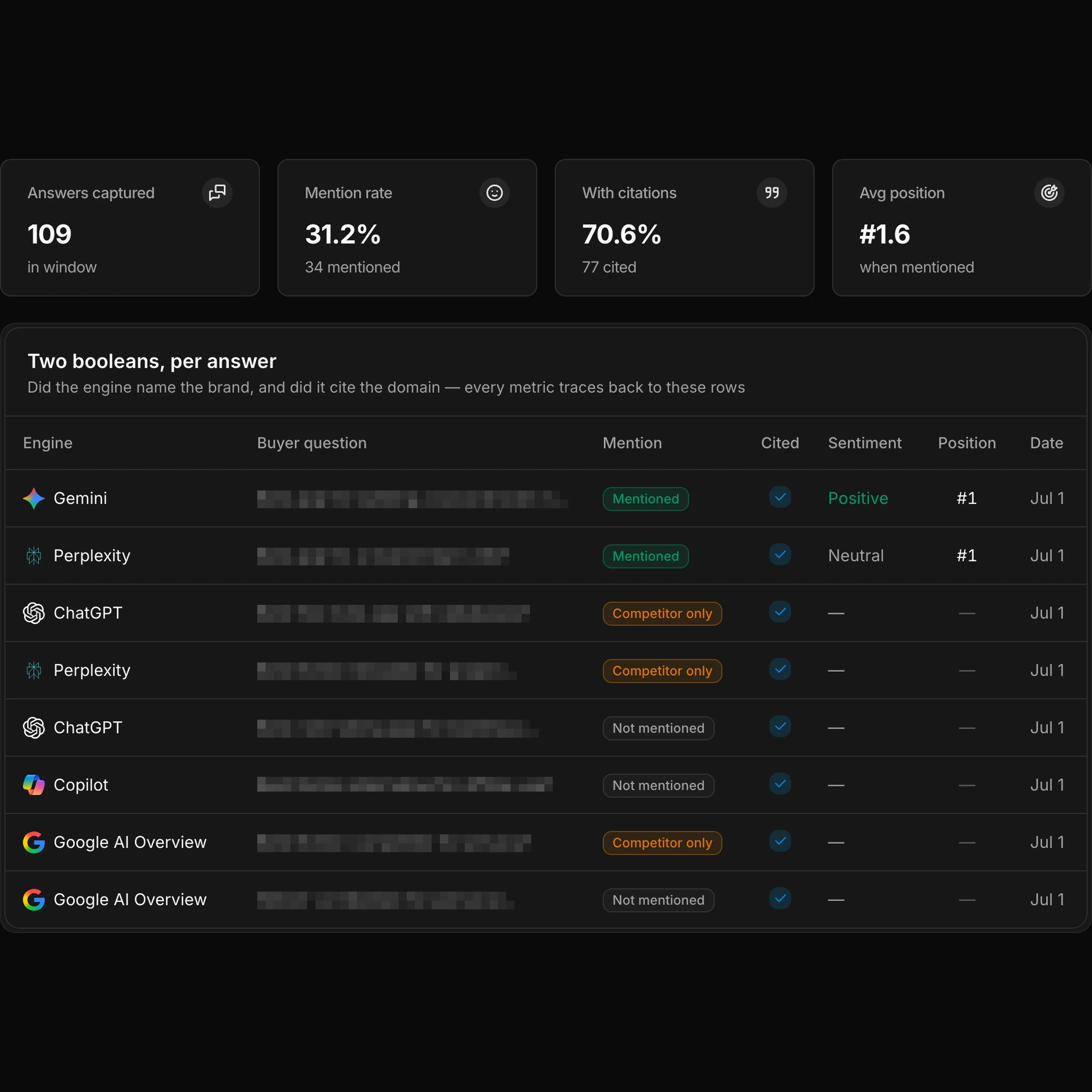
| Jincove | Yes — the two booleans never merge | Every run keeps the answer verbatim, its cited URLs with UTM parameters stripped, and the provider metadata | MISSING — and we have not published one ourselves |
Eight blanks out of nine. That is the state of the category rather than an accusation, and we are standing in it. The practical move is to take retention out of the comparison table and put it in the contract: name the period in the agreement, settle whether answers come out as records or only as a rendered PDF, and pin down what becomes of them a month after you cancel. The source-gap and conversion-gap framework is where the operational consequence lives: both of those diagnoses are read off the stored answer, and a chart cannot produce either one.
What changes at five clients, and at ten
Because the billing units differ, the one figure that compares across this table is what a single client costs per month at a workload you pick. Here is that arithmetic wherever the vendor published enough to do it honestly, and MISSING wherever they did not.
| Product | What one client consumes | At five clients | At ten clients |
|---|---|---|---|
| Peec AI (agency tiers) | One client project against a fixed credit allocation | Growth at $495 covers 25,000 credits and 10 client projects; split five ways that is 5,000 credits each, about 55 prompts per client on 3 models daily, and $99 per client | Same tier, same $495, about 27 prompts each — $49.50 per client, at half the prompt volume. Growth's ceiling is 10 client projects, so the eleventh moves you to Scale |
| LLM Pulse | One project, on the month-to-month weekly-tracking ladder | Scale €299 ÷ 5 projects ≈ €60 per client | Scale+ €599 ÷ 10 ≈ €60 per client; extra projects are €50 each |
| Profound | One client workspace, bought as an add-on | $99 + 5 × $399 = $2,094, so $418.80 per client | $99 + 10 × $399 = $4,089, so $408.90 per client |
| Scrunch AI | One brand workspace on the brands tier, three on Agency Core | Agency Core covers three, so five clients is two subscriptions at $1,000, about $200 per client | Four subscriptions at $2,000. Nothing beyond the three included workspaces carries a published rate, so confirm the fourth before quoting |
| AthenaHQ | Credits, 1 per AI response | Not derivable — the brand allowance on Starter is not stated | Not derivable |
| SE Ranking | One project inside the platform plan | SE Ranking's Core covers 10 projects, so five fit; USD cost MISSING | Ten fit on the same Core tier; USD cost MISSING |
| Ahrefs Brand Radar | Tracked AI prompts, counted account-wide | 20 prompts on the top self-serve tier is 4 per client | 2 per client. A custom check package is the only realistic route |
| Jincove | One workspace per client | Not derivable — scoped per engagement; free sample audit first | Not derivable |
The Peec row deserves a closer look. Because its credits are allocation slots rather than a spending budget, what you buy is a steady-state tracking rate — prompts times active models times frequency — not an allowance you can burn in week one and top up. Workload moves a pooled unit and leaves a fixed allocation where it was. Neither shape wins outright — they break in opposite directions, and the one that suits you turns on whether your clients are roughly the same size or wildly unalike. If you are pricing what you sell on top, see what to charge for GEO services.
Do not shortlist on rank, because there is no rank
Several pages competing for this query order their alternatives by how well each tool ranks your brand in AI. There is no rank in a generated answer. A model writes prose; it does not return an ordered list of ten results with your brand at position four. Any product reporting a position is either reporting the classic search results underneath, or has invented a scale and not said how it is computed.
What you can observe is whether the brand was named in the text, and whether its domain appeared among the cited sources. In practice those two separate all the time. An engine can put a client's name in the recommendation while every source chip under it points at competitors, and it can pull a client's page in as a source while recommending somebody else entirely. Opposite problems, opposite fixes, and one blended visibility percentage hides which one you have.
So the ordering axis that survives is fit, not accuracy — which is why nothing on this page is ranked.
If you are staying on Peec, get five things into the quote
Whether or not you switch, the contradiction table above doubles as a shopping list to pin down in writing before renewal.
- The currency, the billing term and the date, together. Peec publishes a dollar column and a euro column, a monthly rate and an annual one, and the billing control sits on each card rather than at the top of the page. A figure is not an answer until all three are attached to it.
- Models active, not models available. Six available and three active are different numbers, and the coverage has merged them five different ways.
- The price of a fourth model, on your term. The add-on cards open on Annual while the plan cards open on Monthly, which is exactly the trap that made two third-party pages look like they disagreed. Monthly is $35 / $85 / $165 by tier, annual is $30 / $70 / $140. Confirm which one your quote uses.
- What non-expiring credits mean at renewal. They are allocation slots. Confirm what happens to an allocation when a client leaves mid-term.
- Retention and export shape. How long stored answers live, and whether export produces records or a rendered report.
If you are an in-house brand team rather than an agency
An honest redirect, because plenty of people searching for Peec AI alternatives are not agencies, and this page is written from an agency's seat.
If you are one brand with one marketing team, most of what this page weighs — client projects, pooled credits, pitch workspaces, per-client seats, white-label reporting — is machinery you will pay for and never touch. On that footing Peec's own brand tiers are a good fit, as are AthenaHQ's Starter tier and LLM Pulse's Starter and Growth tiers. Jincove is not: we sell to agencies only, and our work is built around a roster. Better said here than discovered on a sales call.
Frequently asked questions
What are the best Peec AI alternatives for an agency managing several clients?
On published information rather than opinion, three shapes exist. For per-project pricing you can plan a retainer against, LLM Pulse publishes project counts, the per-project add-on cost and a euro figure on every tier, including the three Partner ones sized for a roster. If you already pay for an SEO platform, SE Ranking's AI Search add-on avoids a second subscription, though you will read its price in your own browser. If your deliverable is the stored answer rather than a chart, that is the axis we built Jincove on, and we are not neutral about it. Profound publishes both halves of the agency bill — a $99 base and $399 per client workspace — the most linear option here and the easiest to over-buy. Scrunch prices agencies on a separate view of the same page, Agency Core at $500 a month for three brand workspaces.
Are peec.ai alternatives and Peec AI alternatives the same thing?
Yes. Peec AI's website is peec.ai, so the spellings with and without the dot, singular and plural, return substantially the same results and are after the same shortlist. This page covers all of those phrasings. One thing to watch: several pages ranking for these queries are published by companies that place themselves first on their own list, sometimes without saying so above the fold. That is not disqualifying — this page does something similar and discloses it in the second paragraph — but it means the ordering tells you about the publisher rather than about the products.
How much does Peec AI cost?
Brand tiers are $95, $245 and $495 a month for Starter, Pro and Advanced, or €85, €205 and €425 in euros, with annual terms at $80, $205 and $420. Agency tiers are $245 for 10,000 credits, $495 for 25,000 and $795 for 65,000, each with a slider buying more credits inside the same tier. Enterprise and Comprehensive are quotes. Those are Peec's own figures, read on 13 September 2026 in the page's scripts and on screen in a browser — and a browser is the only way most people will see them, because a plain request gets a pricing page with no price on it. It is also why the third-party figures look contradictory when they mostly are not: $95 / $245 / $495 and €85 / €205 / €425 are one ladder in two currencies. Still get it confirmed in writing, dated and in your billing currency, before a retainer depends on it.
Does Peec AI have a free trial or a free plan?
There is no free plan. A trial link appears on the agency pricing page, but no duration is attached to it anywhere we could read — not in the served HTML, not in the scripts that carry the prices, not on the rendered page — so we have written that length as MISSING rather than repeat a number we cannot see. What is published, and is arguably more useful to an agency, is the pitch project: a free prospect workspace on a seven-day window, carrying 25, 50 or 75 prompts on the three priced tiers and unlimited on Comprehensive, with three, five, seven or ten of them open at once depending on tier, each convertible to a paid client project if the prospect signs. Elsewhere in this table, AthenaHQ publishes a genuinely free tier with a $25 credit worth 300 AI responses, and Scrunch lists a seven-day trial on its entry plan.
Where does Jincove sit among these Peec AI alternatives?
Last on the list and not neutral about it, so here is the specific version. Both products sample answer engines on a schedule and report what they say about a brand. The differences that matter: our work is scoped per engagement, where Peec publishes fixed tiers whose agency credits are allocation slots; we cover six engines, where Peec runs three active out of six on self-serve; and our deliverable is the stored answer with its cited URLs rather than a dashboard with export. Where Peec is ahead: unlimited seats on every tier, a shipped pitch-project workflow, and more time in market.
Will I lose my baseline if I move off Peec?
Yes — put it in the budget rather than meeting it in month one. Two products asking the same engine the same prompt on the same day will hand back answers that do not match — partly because the engines are non-deterministic, partly because vendors make different calls on login state, region, which turn they sample and what counts as a mention. A chart that spans the switch is quietly splicing two measurement systems together. The clean handling: keep both products running on the full prompt set for at least two reporting cycles before you cancel, export the old answers as records rather than reports while you still have access, put a changeover marker on every client chart, and say plainly to the client that the series starts again from there.
Read one client's answers before anything reaches a shortlist
Pick a brand you already know inside out and read what the engines actually say about it. That is the quickest test of anything on this page, and it costs nothing. Request a free sample audit. One email, one URL, one brand. We put the questions to ChatGPT, Perplexity and Gemini by hand, then come back inside two business days with each engine's answer, the sources it cited, and whether the brand was named or only cited. Three engines, not six. No card, no account, no sales call. If that is the shape of thing you want on a schedule, the scheduled version is scoped from there.
Last updated: 14 September 2026. Every competitor figure above was read on the page that publishes it, on 11 September 2026 except the lines stamped 13 September, and the links are in the tables so you can repeat the exercise. Three things make that exercise necessary rather than pedantic: three of these vendors served us a currency chosen by our IP and one of those converts from its listed euro price at whatever rate applied the second we loaded it; three serve prices our own capture missed — one behind an audience switch, one assembled in the browser, one sitting in plain sight in the page it serves, in a currency node and an accessibility label our extractor both walked past; and the five third-party pages in the contradiction table carry their own stamps spanning six months. Open the page, note the currency and the billing term, and write down the date before any of it goes into a client quote.
Related blogs
Related Post
Expand your knowledge with these hand-picked posts.

How to Track Brand Mentions in ChatGPT in 2026: The Agency Method
ChatGPT has no Search Console - no impressions, no analytics, no export. Here is the method agencies use to track brand mentions across ChatGPT and the other answer engines without trusting a black-box score, and why "citations" and "mentions" are two different numbers.
Gan Liu
Best AI Visibility Tools for Agencies in 2026: An Honest Shortlist
Most "best GEO tool" roundups rank on engine count. Agencies buy on a different axis - client roster, white-label, and evidence you can hand a client. Here is the honest shortlist, what each tool is actually best at, and the three questions that decide it.
Gan Liu
How to Track Brand Mentions in Perplexity in 2026: The Agency Method
Perplexity shows numbered citations and a Sources list under every answer. The agency method for reading brand mention vs citation off it - no black-box score.
Gan Liu
See what AI says. Then fix it.
Send one brand. Get the answers, the sources, and the first gaps worth fixing.
No card. No call. No catch. Reply in 2 business days.