Scrunch AI Alternatives: What 7 Vendors Publish
Scrunch AI publishes two self-serve tiers, Core at $250 and Agency Core at $500. Seven alternatives for agencies, each price read on the vendor's own page.

TL;DR: Most lists of Scrunch AI alternatives sort on engine count, and for an agency that is the least useful number in the decision. Three things decide it: whether the vendor publishes a price you can put in a client proposal, whether the billing unit divides across a roster, and whether a figure in a dashboard opens back to the answer an engine really gave. Scrunch's own pricing page publishes two self-serve tiers rather than the one a plain fetch returns: Core at $250 a month with 125 prompts and a single brand workspace, and Agency Core at $500 with 250 prompts, three brand workspaces, three pitch workspaces and unlimited user licences. Seven options are below, each price read on the vendor's own page, with MISSING wherever no figure reached us by any route.
Two disclosures first. Jincove sells AI visibility monitoring to agencies, so every product named here is a competitor and Jincove is one of the seven; we are not affiliated with Scrunch, Sitecore or any vendor below. And nothing here ranks these products on data quality: a controlled comparison of AI visibility tools is MISSING from the pages we read, and we have not run one ourselves either.
This is a switching page, not a category review. For the long profile of every vendor in the category, read the AI visibility tool shortlist for agencies — the blocks below deliberately do not repeat it. For the buying script that works on any vendor in any year, read the twelve questions to ask an AI visibility provider.
The Scrunch AI alternatives, side by side
Three columns, because those are the three things that change when you stop paying Scrunch and start paying someone else. There is no engine-count column on purpose: the number alone decides nothing, and which engines on which tier is what matters — that sits in the vendor blocks below. Prices are as each vendor's own page published them to us on 11 September 2026, except four read on 13 September 2026: Scrunch's agency tier, which a plain HTTP request does not render and was read from the page's own script bundle; Profound's per-client agency rate, which sits on its agency page rather than its pricing page; LLM Pulse's Partner and daily-tracking prices, whose euro figures sit in the aria-label on each plan's button while the card itself renders in your local currency; and Peec AI's whole ladder, which ships as constants in the Framer modules its pricing pages load. Three annual-billing figures came later, read on 14 September 2026: Peec AI's dollar rungs, LLM Pulse's ten-month year, and AthenaHQ's 17% discount.
| Option | Price you could quote a client today | Does the billing unit divide across a roster? | White-label, as the vendor's page states it |
|---|---|---|---|
| Scrunch AI (staying put) | Core $250/mo on the brands tab; Agency Core $500/mo on the agencies tab — scrunch.com/pricing. Enterprise: MISSING, custom quote | On Agency Core, up to a point — 3 brand workspaces, 3 pitch workspaces and unlimited licences per subscription. On Core, no: 125 prompts, 5 licences and 1 workspace, capped per plan | The agencies page offers to "fully white-label outputs for clients", with no price attached |
| Profound | Starter at $99/mo and Growth at $399/mo — tryprofound.com/pricing. Both are month-to-month rates: the "Billed yearly" switch beside each price arrives off, and turning it on trades two months free, so $82.50 and $332.50 a month. Its agency plan is priced on its own agency page instead: $399/mo per client workspace, $199/mo per five pitch workspaces | Yes — a client workspace is a flat $399/mo, each carrying 100 tracked prompts and 400 agent credits a month | Not stated on the pricing page or the agency page |
| Peec AI | Agency tiers Essential $245/mo for 10,000 credits, Growth $495 for 25,000, Scale $795 for 65,000 — €205, €425 and €675 at the same rungs; brand tiers $95, $245 and $495 — peec.ai/pricing-agencies. A plain fetch returns the credit tiers with the price cells empty; the figures ship as constants in the page's own Framer bundle. On annual terms the three agency rungs are $205, $420 and $675 a month | Yes — credits, and the tiers are sized by roster (3–10 clients, 11–25+) | Promised in the agency page headline; no price attached |
| AthenaHQ | Essential free with 300 credits; Starter $295/mo for 3,600 credits — athenahq.ai/self-serve-pricing. The toggle arrives on monthly; annual billing takes 17% off, though the discounted figure itself is not printed. API and extra credits are add-ons priced on request | Yes — one credit equals one AI response | Not stated on the pricing page |
| LLM Pulse | Tracking weekly: Starter €49/mo, Growth €99/mo, Scale €299/mo, Scale+ €599/mo, Scale++ €1,199/mo, then three Partner tiers at €1,499, €1,999 and €3,799 for 25, 30 and 35 client projects — llmpulse.ai/pricing. The same rungs run daily are €79 to €1,899, and Partner €2,399 to €5,999. Extra projects €50/mo each, extra models from €10/mo. Annual billing is ten times the monthly rate | Partly — prompts and projects are capped per tier, but projects are buyable singly | Enterprise and Partner tiers only |
| Otterly.AI | Lite $29/mo, Standard $189/mo, Premium $489/mo; Enterprise from $1,000/mo — otterly.ai/pricing. The plan grid is JavaScript-rendered; the figures also sit in the page's own meta description | Yes — unlimited workspaces on Standard and above, unlimited team members on every tier | Promised on its agency page, with no price attached; MISSING from the pricing page |
| Writesonic | Agency Starter $200/mo billed annually, pitch projects only; ongoing tracking converts from $150/project/mo — writesonic.com/pricing/agencies. The month-to-month figure is not printed, but the page's own $600 annual saving and Save 20% badge put it at $250/mo | Partly — 2,000 answers and up to 20 pitch projects a month with unlimited users, but each pitch project auto-pauses after 7 days; ongoing clients bill per project | Agency Enterprise only |
| Jincove (ours) | Scoped per engagement; free sample audit first. No self-serve signup, no free plan | Not applicable — work is scoped per engagement, with a workspace per client | Listed as coming soon. Not shipped |
Every vendor here other than us publishes a currency figure. What separates them is not whether they price in public but how far you have to travel to read it, and for four of those seven, the number sat outside what our plain-text capture returned. Here is where each of those four figures actually lives. Scrunch's agency tier reached us only once JavaScript had run. Writesonic prints the annual rate and leaves the monthly one to be derived from its own stated saving. LLM Pulse keeps every euro figure in the aria-label of a plan button while the card face renders in whatever currency your location resolves to — ours came back in yen — with the vendor's own euro conversion table stopping one rung short of its three Partner tiers. And Peec AI builds its plan cards client-side, so its figures ride along as constants in the page's own Framer bundle: the agency page loads thirty-six JavaScript modules, one of which carries the whole ladder. If you bill clients, a number you cannot read is a number you cannot quote, and that cost is real even when the vendor did publish it. But a number you have to open a script bundle or an accessibility attribute to reach is still a published number. It is just not one a fetcher, an archive capture, or a roundup built from either will ever show you — which is why an empty price cell in anyone's comparison table, ours included, is evidence about the crawler and never about the vendor.
Why people are shopping in 2026, and when staying is the right answer
Scrunch is not a weak product, and a switching guide that pretends otherwise is selling you something. It pairs brand monitoring with AI-crawler analytics and page audits, an uncommon combination. If you sit in-house at a large or mid-market brand, you have one name to watch, you care how agents and crawlers traverse your site, and your organisation already runs Sitecore, then the sensible move is to stay and negotiate your renewal.
What changed is ownership and shape rather than quality. Sitecore announced on 3 June 2026 that it had acquired Scrunch, in its own newsroom release. That release states no purchase price. Bloomberg, paywalled put the figure at roughly $225 million on the same day and Adweek reported it from there, noting that Sitecore declined to confirm the value. We could not confirm that number at first hand, so treat it as reported rather than established.
An acquisition matters for procedural reasons rather than sentimental ones: a platform absorbed into a larger suite inherits the parent's contracting motion, renewal calendar and packaging logic, and contracting is what an agency feels first. Several roundups ranking for this query were last updated before June 2026, so they describe a company under different ownership.
The second reason is more ordinary. If you bill clients, your cost base has to be quotable before the proposal goes out. Scrunch does publish an agency rate, $500 a month for Agency Core, but its agencies page — prospecting environments, multi-client workspaces, referral commissions of up to 20% — attaches a price to none of that, and anything above the two published tiers is a sales cycle of its own. The client asked for the number last week.
What Scrunch AI costs, on both tabs
Every figure in this table comes from scrunch.com/pricing. The brands side was read on 11 September 2026 and re-read on 13 September; the agency side was read on 13 September. Two things are worth knowing before the numbers. The page carries a For brands / For agencies toggle, and a plain HTTP request renders only the brands side, which is why a fetcher, an archive capture and most roundups report a single tier. Both tiers, and the FAQ answers underneath them, ship as constants in the page's own script bundles (_astro/PricingContent.wiFHfPhS.js and _astro/data.BzseqRWW.js), which is where the agency column below comes from. Carry that distinction to every vendor on this page: a panel that does not render to us is not a price a vendor declined to publish.
| What the page publishes | Core (brands tab) | Agency Core (agencies tab) | Enterprise |
|---|---|---|---|
| Monthly price | $250/mo | $500/mo | MISSING — custom quote |
| Annual rate, per month — carried in the page's pricing script, never rendered | $208 ($504 off a year) | $417 ($996 off a year) | MISSING |
| Unique prompts | 125 | 250 | Custom |
| Brand workspaces | 1 | 3 | Custom |
| Pitch workspaces | — | 3, marked partner only | Custom, on the agencies tab only |
| User licences | 5, then $25/mo each or $75/mo for five more | Unlimited | Custom |
| Prospecting licences | — | 1 per brand | Custom, on the agencies tab only |
| LLMs supported | 4 — ChatGPT, Perplexity, Google AIO, Copilot | The same 4 | Counted as "All (8)" in the feature matrix, though the Enterprise engine list in the same bundle names nine: it adds Claude, Gemini, Meta AI, Google AI Mode and Grok |
| Site audits | 5 a month | 5 per brand a month | Full site audit(s) |
| Other published caps | 3 personas, 2 languages, 1 country, 5 competitors, 25 site-map pages, 1 page optimisation a month, 3 trend topics | The same, except the audit, site-map and optimisation caps are per brand, and 6 trend topics | Custom, with countries unlimited |
| Published routes out of the data | — on all five (Looker Studio, query API, MCP, CLI, advanced API) | Looker Studio included; MCP and CLI marked coming soon on the vendor's own grid; query API partner only; advanced API a dash | Looker Studio, query API and advanced API included, MCP custom, plus the Agent Experience Platform |
| SSO (SAML, OIDC) | — (Google sign-on only) | — (Google sign-on only) | Included |
| Onboarding and support | Self-serve, email only | About 30 minutes of training, email | Dedicated account team |
Two answers the same bundle carries are worth having in writing before you sign. An extra user on Core is $25 a month, or $75 for five more. The annual-pricing answer is written about Enterprise agreements and promises a discount equivalent to two months free — which is exactly the discount the page's own pricing script already carries for the self-serve tiers, $208 and $417 a month against $250 and $500. Those two figures are in the data the page ships and in the table above, but the cards render the monthly number only and the page has no annual toggle, so a buyer reading the page will never see them. Ask for them by name.
Three things this table makes visible that competing roundups flatten:
- Which tier you find depends on which tab you land on. Core is one brand: $250, 125 prompts, one workspace. Agency Core is three: $500, 250 prompts, three brand workspaces and three pitch workspaces. At three clients that is about $167 a brand a month against $250 on the brands tier, so the agency tab is cheaper per brand, not dearer.
- Seats are priced on one tab and unmetered on the other. Core includes five licences and prices the sixth at $25 a month; Agency Core publishes unlimited licences. If you are sizing a client services team, that difference is worth more than the gap between $250 and $500.
- The two tabs answer a multi-brand buyer differently. The brands-side FAQ says pricing is charged per brand per month and points anyone tracking more than one brand at Enterprise; the agencies tab publishes three brand workspaces for $500. Ask which of the two your quote is being written against.
Every number here carries a date because this category re-prices often, and because a screenshot in somebody else's roundup is not a source.
How we picked, and where we are biased
The selection rule was narrow: a tool qualifies if it reports what answer engines say about a brand, and if a person could reach a pricing or plan page for it on 11 September 2026. That excludes several well-regarded products, because this is a switching list for people already paying Scrunch. Where a pricing page rendered only one side of a toggle, we went back and read the constants in the page's own script bundle rather than recording the other side as unpublished.
We ranked nothing and scored nothing. The table is ordered by role rather than merit, because merit here depends on whether you run one brand or twenty. We did not buy and run these products side by side, so we make no claim about relative data accuracy. Anyone claiming their tool is more accurate than another is describing a test nobody has published.
Where we are biased: Jincove is on the list and we built it, we sell measurement rather than placement, and we promise nothing about what any engine will say about anyone. Jincove's limits get a section of their own below, because a list where the author's product has no downsides is not a list.
Of the five competing roundups we opened on this query the same day, one attached a check date to a single vendor's price, none attached a source URL to a tool's figure, and none stated a sampling protocol — how many prompts, across which engines, run how many times — though two described hands-on testing. We did not open all thirteen results. One we went back for, aiclicks.io, does date its prices to July 2026 and link a vendor page, so the practice is not unheard of. It is just rare, and July was two re-pricings ago.
What each vendor commits to storing
Here is the column the other lists leave out. When a client disputes a single row in a quarterly review, a chart does not survive the meeting; the answer the engine gave does. So we checked what each vendor's pricing or plan page commits to about the underlying record.
| Option | What the published page says about the stored answer |
|---|---|
| Scrunch AI | Platform pages describe tracked responses, citation and source breakdowns and page audits. Core publishes a dash against every route out of the data; Agency Core publishes Looker Studio access outright, flags MCP and CLI access as coming soon on the same grid, and marks the query API partner only. Retention period and raw-answer export: not stated on either tab |
| Profound | Pricing page counts prompts tracked and agent credits, and its feature grid lists all-time data history with CSV and JSON export. Which tier carries each did not render to us. Verbatim-answer storage: not stated |
| Peec AI | Plan pages convert credits into prompts by model and frequency, and list custom CSV exports plus a Data Studio connector. Retention and raw-answer export: not stated |
| AthenaHQ | Defines one credit as one AI response and lists CSV export on Starter. Retention: not stated |
| LLM Pulse | Counts tracked prompts per plan and lists CSV, Excel and PDF export on every plan. Retention and raw-answer export: not stated |
| Otterly.AI | Counts search prompts per plan, lists detailed reports and export on every tier and a Looker Studio connector from Standard up. Retention and raw-answer export: not stated |
| Writesonic | Counts answers per month and lists shareable audit reports. Retention: not stated |
| Jincove | Each delivered run keeps the answer word for word, the cited sources with tracking parameters stripped off, and the provider metadata. Our published retention period: MISSING — we do not commit to one yet |
We read pricing and plan pages, not support centres or contracts. A vendor may document retention elsewhere; what we are telling you is that it was not on the page where you decide to spend money. Ask in writing, and notice how long the answer takes to arrive. One row here rests on a single read: Otterly.AI's plan grid returned to us on 11 September and answered a bot challenge on 13 September, so its export line has not been re-confirmed since.
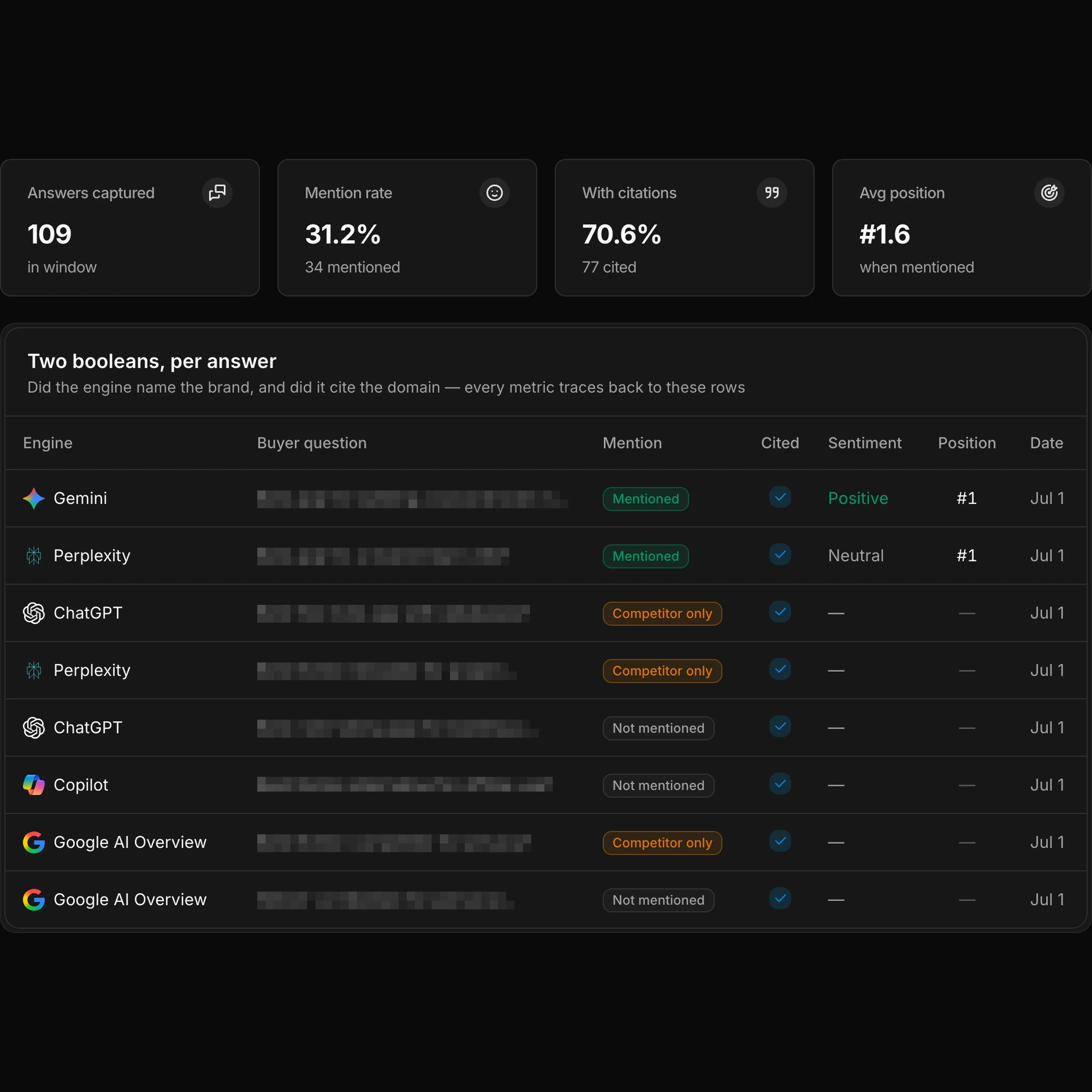
This column is also where the two numbers that matter get separated. Being named in an answer and having your own domain cited as a source are different events with different fixes, which is why we keep them as two plain true-or-false values instead of folding them into one score — see the difference between being named and being cited and why we report evidence instead of a score.
If you leave Scrunch, where each option lands you
Four lines each, answering the two migration questions rather than profiling the product: what Scrunch gives you that this vendor does not, and what the move costs. Comparisons run against Core unless the agency tier changes the answer. The long profiles live in the category shortlist; repeating them here would just be a second roundup.
Profound. You lose engines on the way in: the $99 Starter covers ChatGPT only and the $399 Growth covers three, adding Perplexity and Google AI Overviews, where Scrunch Core covers four and includes Copilot. Prompt capacity drops too, from Core's 125 to 50 or 100. What you gain is the most polished analytics surface here, a published data section listing all-time history with CSV and JSON export, which Core does not offer at all, and a roster price you can put in a proposal today: $399 a month per client workspace, plus $199 for every five pitch workspaces. That per-client figure does not taper — it is the same at your third client and at your thirtieth — so model it at ten clients before you compare it with a tiered plan.
Peec AI. The unit changes: you stop buying a prompt cap and start buying a credit budget that moves with model count and frequency, so the question becomes how many answers a month, not how many prompts. In exchange you get tiers sized by roster — Essential, Growth, Scale, Comprehensive — and a client-workspace structure Core lacks, though Scrunch's own agency tier has one too at three brand workspaces. The number is published, just not where a fetch will find it: $495 a month for 25,000 credits at the tier the vendor sizes for 3–10 clients, $795 for 65,000 at 11–25+, with brand tiers at $95, $245 and $495. What you have to model is the conversion rather than the price: the same roster costs different amounts depending on how often you run it, which is the one variable a fixed prompt cap settles for you. Custom CSV exports and a Data Studio connector are listed; retention and raw-answer export are not.
AthenaHQ. The only free door here, which mid-migration means you can run it beside a live Scrunch account before you give notice: Essential, 300 credits, one credit per AI response. On paid, Starter's $295 buys 3,600 credits. Sizing that against Scrunch takes an assumption the page does not supply: Scrunch's own tooltip puts 125 prompts across four models at 500 responses per cycle, and nowhere says how long a cycle is. Run weekly, that is roughly 2,170 responses a month and 3,600 credits cover it with room left; run daily, it is nowhere close. Get the run frequency in writing before you treat the two as equivalent. Model coverage goes up rather than down: Copilot is included, alongside Claude, Grok and more. What the move does not solve is the roster, because no agency rate is published and API access and extra credits are add-ons priced on request.
LLM Pulse. The most legible ladder in the group, and the one row in this table where run frequency carries its own price column: €49, €99, €299, €599 and €1,199 buy 50, 150, 450, 1,200 and 2,400 prompts across 1 to 15 projects at weekly, and €79 to €1,899 buy the same rungs at daily. Scrunch Core's 125 prompts lands on Growth either way, €99 weekly or €149 daily, which is why the run-frequency question above is not pedantry. The engine you lose is Copilot, and the pricing page says so itself: its FAQ puts Copilot, Claude, DeepSeek, Grok and Alexa for Shopping on the paid add-on list for every tier, from €10 a month, with ChatGPT, Perplexity, Gemini, AI Mode and AI Overviews in the base price. You gain seats that are not metered — the page puts team members on every plan at no charge — plus CSV, Excel and PDF export throughout. The three Partner tiers actually sized for a roster publish a figure too: €1,499, €1,999 and €3,799 a month for 25, 30 and 35 client projects, carrying 3,600, 5,000 and 10,000 prompts, with white-label bundled into them at three grades — your logo on an llmpulse.ai subdomain, the whole platform under a domain of yours, or dashboards dropped into your own client portal — and kept to Enterprise otherwise.
Otterly.AI. The closest engine match on this list: its base four are ChatGPT, Perplexity, Microsoft Copilot and Google AI Overviews — the same four Core covers, so nothing goes dark on day one. It is also the cheapest published ladder, Lite $29 for 15 prompts, Standard $189 for 100 and Premium $489 for 400, which puts Scrunch's 125 prompts between Standard and Premium. The roster shape improves rather than degrades: unlimited workspaces from Standard up and unlimited team members on every tier, against Core's single brand workspace and Agency Core's three. The costs are that Claude, Gemini and Google AI Mode each bill as an extra on top, and that the plan grid is JavaScript-rendered.
Writesonic. The one page in this group headed agency pricing that shows a figure the moment it loads: Agency Starter at $200 a month billed annually. What that $200 buys is prospecting, not the retainer — each pitch project runs one to seven days and then auto-pauses, up to 20 a month, inside 2,000 answers with unlimited users. Converting a winner to ongoing tracking starts at $150 per project per month, so a six-client roster is a different bill from the headline. Fits an agency whose bottleneck is winning the pitch rather than reporting the retainer; rebranded reporting is Agency Enterprise.
One question these pages barely answer: whether your Scrunch prompt set and its history can come with you. Only Peec AI names anything close, listing bulk prompt import on its plan comparison; nobody mentions carrying history across. Core itself shows a dash against Looker Studio, the query API, MCP, CLI and the advanced API, so on the brands tier there is no documented route out except the dashboard. Agency Core opens three of those five, but only Looker Studio is shipped: the vendor's own grid flags MCP and CLI as coming soon, so one route out is live and two are announced. That is still a reason to read both tabs before you assume you are locked in. Ask about export before you give notice, not after.
Free Scrunch AI alternatives: what actually exists
The honest answer to "is there a free one" is: one genuine free tier, a lot of trials, and a great deal of marketing language in between.
AthenaHQ's Essential tier is free and includes 300 credits, where a credit is one AI response — enough to sanity-check one brand across a handful of prompts. Scrunch itself offers a seven-day trial with no card, which is a trial and not a free tier. Otterly.AI's pricing FAQ mentions a trial for new accounts without naming a length, and its cheapest paid rung is $29 a month, which is closer to free than most things here.
Jincove has no free plan and no self-serve signup. Our console is in early access, so there is nothing to sign up for today. What we offer instead is a free sample audit run by a person: one brand, one URL, one email, hand-run on ChatGPT, Perplexity and Gemini, with a mini evidence report back inside two business days. Three engines, not six — the other three run on the paid pipeline. No card, no account, no sales call. If what you want is a free self-serve dashboard, we are the wrong vendor and AthenaHQ's Essential tier is the place to look first.
The free method that works everywhere is still a spreadsheet: ten buyer questions, run by hand, two true-or-false columns. It takes an afternoon and produces a baseline no demo can talk you out of.
What changes when you bill a roster instead of one brand
Scrunch's brands tier is sized for one brand watching itself, and its agency tier stops at three. The moment the same subscription has to carry six clients, three things break, in this order.
The billing unit stops being cosmetic. Scrunch publishes both shapes and they behave differently: Core's 125 prompts, five licences and one workspace do not partition at all, while Agency Core's 250 prompts and three brand workspaces partition three ways and then stop. Six clients means two Agency Core subscriptions, about $1,000 a month and roughly 83 prompts a client. Credits and answer counts divide cleanly; fixed prompt-and-workspace caps divide in lumps. Model the bill at ten clients, not one.
Seats are account managers. Scrunch answers this on both tabs, and the answers differ: Core includes five licences and prices the sixth at $25 a month, Agency Core publishes unlimited licences. Three other vendors here remove the question too — LLM Pulse and Otterly.AI both say team members are unmetered, and Writesonic's agency tier says the same of users. Get a marginal seat price in writing from anyone who publishes neither a figure nor an unmetered plan.
The deliverable has to carry your name. If the report carries the vendor's logo, you are reselling someone else's product at their margin. This is the thinnest part of the category, and exactly one vendor attaches a number to it: LLM Pulse bundles white-label into its Partner tiers, from €1,499 a month for 25 client projects — though the same page's own feature grid leaves the Partner tiers out of its columns altogether and ticks white label for Enterprise alone, so get in writing which of the two you are buying. Writesonic puts it on Agency Enterprise. The Scrunch, Peec AI and Otterly.AI agency pages promise white-labelled client output with no price beside it, it is absent from the other pages we read, and at Jincove it is listed as coming soon rather than shipped. If rebranded client reporting is a hard requirement this quarter, take every vendor's answer at face value, ours very much included. The structure such a report should follow is in our guide to white-label GEO reports, and how to price the service around it is in what to charge for GEO services.
Where Jincove does not fit
We put ourselves on the list, so here is the part vendors leave out.
Jincove is the wrong choice if you are a single in-house brand team: you would pay for roster machinery you never use, and a cheaper tracker or AthenaHQ's free tier does that job better. It is wrong if you need to start today, because there is no self-serve signup and no free plan. It is wrong if rebranded client reporting has to ship this quarter, since ours has not. It is wrong if you want sentiment scoring, hallucination detection or fact-checking of AI answers, because we do none of those. It is wrong if your clients sell into China, because we do not cover Chinese engines. And it is wrong if what you want is one visibility number — we deliberately do not produce one, which some buyers find genuinely irritating.
On engines, stated conservatively: paid work covers all six — ChatGPT, Perplexity, Gemini, Google AI Overviews, Google AI Mode and Microsoft Copilot — and the free sample audit covers three.
A two-week parallel test to run before you switch
Do not switch on a demo. Run the two tools side by side for a fortnight on one real client, and freeze the variables. This is a measurement protocol, not a performance experiment: it tells you which tool records the world more usefully, not which one improves anything.
- Freeze a prompt set of 15 to 25 buyer questions for one client and change nothing for the two weeks. Real question shapes — "best X for Y", "alternatives to Z" — not brand lookups.
- Fix the run count. Three runs per prompt per engine, same weekday, roughly the same hour. Answers vary between runs, and one run per prompt tells you almost nothing.
- Fix login state, country and language, and write all three down. A signed-in ChatGPT session and a signed-out one are different instruments.
- Record two true-or-false values per answer: was the brand named, and was the client's own domain among the cited sources. Nothing else. Resist the urge to score.
- Export from both tools on day fourteen and reconcile ten rows by hand against the stored answers. A tool that cannot show its own raw answer has failed the test, whatever the dashboard says.
- Write down what changed and what you changed, but do not join the two. Answers move for reasons no vendor can isolate, and any tool or article claiming a fix caused a change is overselling.
If you would rather see the output before building the harness, we will run the first pass by hand for free on three of the six engines, and what comes back is the answers themselves with the sources each one cited.
Scrunch AI alternatives: questions people ask
Which Scrunch AI alternatives work for an agency with a client roster?
Filter on three things, in this order. First, a published price for multi-client work. Five of the seven besides ours publish one: Scrunch at $500 for Agency Core, on its agencies tab; Profound at $399 per client workspace, on its agency page; Peec AI at $495 for 25,000 credits, the tier it sizes for 3–10 clients; LLM Pulse at €1,499 for a Partner tier carrying 25 client projects; and Writesonic at $200 billed annually, for pitch projects rather than ongoing tracking. Otterly.AI names no agency rate but sells unlimited workspaces from $189 up — a roster price by another name. Only AthenaHQ routes multi-client buyers to a quote. Second, whether seats are metered, because account managers multiply faster than clients do. Third, whether the billing unit divides across a roster — credits and answer counts do, fixed prompt-and-workspace tiers only in lumps.
Is Scrunch still an independent company?
No. Sitecore announced the acquisition on 3 June 2026 in its own newsroom, and the product now sits inside a larger digital experience suite. Sitecore's release states no purchase price; Bloomberg reported roughly $225 million the same day behind a paywall and other outlets followed, which we could not verify at first hand. In practical terms the product still sells self-serve at the two tiers listed above, and the old scrunchai.com pricing URL now redirects to scrunch.com. Watch contracting and packaging, since those usually change first when a platform joins a suite.
How much does Scrunch AI cost per month?
On 13 September 2026 Scrunch AI pricing published two self-serve tiers, one on each tab of the same page. Core is $250 a month, with 125 unique prompts, one brand workspace, five user licences, five site audits a month and four engines: ChatGPT, Perplexity, Microsoft Copilot and Google AI Overviews. Agency Core is $500 a month, with 250 prompts, three brand workspaces, three pitch workspaces and unlimited licences. The pricing script also carries annual rates of $208 and $417 a month, but no toggle renders either on screen. A sixth licence on Core is $25 a month. Enterprise is a custom quote adding five more engines, the Agent Experience Platform, API and Looker Studio access and SAML or OIDC sign-on. A plain fetch of the page returns the brands tab only, so open both before you quote a client.
Are there free alternatives to Scrunch AI?
One genuine free tier: AthenaHQ's Essential, with 300 credits, where a credit is one AI response. Almost everything else advertised as free in this category is a trial, including Scrunch's own seven-day one and the free trial mentioned in Otterly.AI's pricing FAQ. Jincove has no free plan and no self-serve signup at all; what we offer instead is a sample audit run by a person on one brand, hand-run on ChatGPT, Perplexity and Gemini, returned within two business days with no card required. For an ongoing free method rather than a free product, ten hand-run prompts in a spreadsheet with two true-or-false columns still works.
Can any of these tools white-label reports for my clients?
Rarely, and almost never on an entry plan. On the pages we read on 11 and 13 September 2026, one vendor published a price you could act on: LLM Pulse bundles white-label into its Partner tiers, which start at €1,499 a month for 25 client projects, though its own feature grid ticks white label for Enterprise alone. Writesonic puts it on Agency Enterprise. The Scrunch, Peec AI and Otterly.AI agency pages each promise white-labelled client output in prose, and on all three the price beside that promise is MISSING. Where they differ is where the promise sits: for Scrunch and Otterly.AI it lives on an agency page separate from the pricing page, while Peec AI has no separate agency page at all — peec.ai/agencies answered 404 on 2026-09-14 — so its promise sits in the subhead of peec.ai/pricing-agencies, the same page that carries its figures. Jincove's own white-label is listed as coming soon and has not shipped. If a rebranded client PDF is a hard requirement, make each vendor answer in writing whether it is shipped, on the roadmap, or partner-programme-only — those are three very different answers.
Do I need to rebuild my baseline when I switch tools?
Assume yes, and budget a fortnight for it. Tools differ in how they sample — run frequency, login state, country, language, and whether a prompt runs once or several times — so historical charts from two platforms are not comparable even when the axis uses identical words. Export everything from the outgoing tool before the contract lapses, raw answers included if the vendor allows it, then run the two-week parallel test above so the new baseline belongs to you rather than being inherited. Presenting the join between two vendors' charts to a client as one trend is the thing not to do.
Related blogs
Related Post
Expand your knowledge with these hand-picked posts.

How to Track Brand Mentions in ChatGPT in 2026: The Agency Method
ChatGPT has no Search Console - no impressions, no analytics, no export. Here is the method agencies use to track brand mentions across ChatGPT and the other answer engines without trusting a black-box score, and why "citations" and "mentions" are two different numbers.
Gan Liu
Best AI Visibility Tools for Agencies in 2026: An Honest Shortlist
Most "best GEO tool" roundups rank on engine count. Agencies buy on a different axis - client roster, white-label, and evidence you can hand a client. Here is the honest shortlist, what each tool is actually best at, and the three questions that decide it.
Gan Liu
How to Track Brand Mentions in Perplexity in 2026: The Agency Method
Perplexity shows numbered citations and a Sources list under every answer. The agency method for reading brand mention vs citation off it - no black-box score.
Gan Liu
See what AI says. Then fix it.
Send one brand. Get the answers, the sources, and the first gaps worth fixing.
No card. No call. No catch. Reply in 2 business days.