Profound Alternatives for Agencies: 8 Compared in 2026
Eight Profound alternatives compared on billing unit, engines listed, stored evidence and cost per client, with every price read on the vendor's own page on 11–13 September 2026 or marked MISSING.

TL;DR: Most Profound alternatives are not sold in the same unit, so what decides your margin is not the sticker price but what one client costs per month once you convert every tier into your own workload. Of the nine products below — eight alternatives plus Profound as the baseline — four published a figure we could read outright on 11 September 2026 and a fifth only in its page metadata, two rendered their figures solely in the currency of our requesting IP with no dollar equivalent published, one put its figures only inside the page's own script bundle, where a plain fetch never sees them, and the ninth, ours, is scoped per engagement. The column nobody fills in is evidence: whether the platform keeps the raw answer a number came from, and for how long. On the pricing and agency pages we read, no vendor states a retention period — ours included. Every figure below travels with the URL it came from and the day we opened that URL, and every gap is written MISSING with the routes we tried beside it rather than filled in by guesswork.
Read two things about the author before the table. Jincove sells AI visibility monitoring to agency buyers, which makes every product listed here a competitor of ours; we hold no partnership, reseller deal or affiliate arrangement with Profound. Our own row sits in the table, and it carries its own paragraph on who should walk away from us.
Two sibling pages carry what this one leaves out. Single-vendor depth — Profound's own tiers, response caps and per-client add-on pulled apart one by one — belongs to a dedicated Profound pricing breakdown rather than a section here. For choosing inside the category from scratch rather than switching away from one product, see the full category roundup for agencies. This page answers a narrower question: if you are on Profound or about to be, who else does the same job, in what unit, and what is left in the file afterwards.
The shortlist at a glance
Profound stays in as the baseline, not as a candidate. Every price is what the vendor's own page handed us on 11 September 2026, with two exceptions re-opened on 13 September 2026 — Scrunch AI and Peec AI, where the first pass had walked past a second pricing tab and a script bundle respectively. Unless a cell says otherwise the figure rendered in the page body, and none of them is a negotiated quote. The order is the order we read them in, not a ranking.
| Product | Billing unit | Published entry price (read 2026-09-11; Scrunch AI and Peec AI 2026-09-13) | Engines its page lists | Multi-client and white-label |
|---|---|---|---|---|
| Profound (baseline) | Unique prompts per tier, plus a per-client workspace add-on | Starter $99/mo, Growth $399/mo, both month-to-month by default ($82.50 and $332.50 with the page's yearly switch on); Agency Growth $99/mo plus add-ons; Enterprise custom | ChatGPT alone at the entry tier; three one step up, once Perplexity and Google AI Overviews join it; the nine-engine list is Enterprise. Agency client and pitch workspaces run the same three as Growth | Agency Growth base $99/mo; client workspace $399/mo each; 10 pitch workspaces included, 5 more for $199/mo; 5 seats |
| Peec AI | Credits, converted to prompts by an on-page configurator | Essential $245/mo (10,000 credits), Growth $495 (25,000), Scale $795 (65,000), with €205 / €425 / €675 alongside them — carried in the page's own script bundle, not in the HTML a plain fetch returns; re-read 2026-09-13 | "Choose 3 models" on brand tiers; up to 13 on Enterprise | Tiers sized for 3–10 and 11–25+ clients; free pitch projects; one invoice |
| Scrunch AI | Unique prompts and brand workspaces per tier, on separate brand and agency tabs | Core $250/mo ($208 billed yearly) on the For brands tab; Agency Core $500/mo ($417 yearly) on the For agencies tab of the same URL, which renders only in a browser; Enterprise custom — re-read 2026-09-13 | Four at the entry tier, named on the card: ChatGPT, Perplexity, Google AI Overviews, Copilot. Nine at Enterprise, adding Claude, Gemini, Meta AI, Google AI Mode and Grok. The same two lists run on both tabs | 1 brand workspace and 5 licences on the brands tab; 3 brand workspaces, unlimited licences and 3 pitch workspaces marked Partner Only on Agency Core; its agency page adds white-labelled outputs and up to 20% referral commission; rate for a fourth brand workspace MISSING |
| AthenaHQ | Credits, where 1 credit = 1 AI response | Starter $295/mo (3,600 credits); free tier with a $25 credit; Enterprise custom | The Starter card says 11 and carries a logo for each, named on hover. Five of them — ChatGPT, Perplexity, Gemini, Copilot and Google AI Overviews — also sit on the free card; Starter adds Claude, Mistral, Grok, Meta AI, DeepSeek and Google AI Mode, plus a twelfth slot for models on request. The free card carries those five and states no count — read 2026-09-13 | Unlimited seats; brands per Starter plan not stated; white-label not listed |
| LLM Pulse | Tracked prompts and projects per tier | €49 / €99 / €299 / €599 / €1,199 on the weekly-tracking setting its page loads by default; the same five rungs run daily are €79 / €149 / €449 / €899 / €1,899 (read 2026-09-14). The vendor's own USD column read $60 / $122 / $366 / $733 / $1,467 on the day we read it — the page refreshes those conversions daily | 5 AI models on every self-serve tier | 1 / 2 / 5 / 10 / 15 projects, the same counts on either tracking frequency; Partner tiers carry 25–35 projects and are priced in the same card grid, their euro figures carried in each button's aria-label; the vendor's own EUR/USD conversion table runs Starter through Scale++ at weekly tracking; white-label is Enterprise |
| SE Ranking | SEO platform plan plus a separate AI Search add-on | MISSING in USD — rendered to our IP in yen: Core ¥17,455–¥21,819/mo by billing term, AI Search add-on from ¥10,478/mo | 5 LLMs on both tiers; the AI Search add-on names AI Overviews, AI Mode, Perplexity and ChatGPT. Limits are stated as daily AI prompts (100 on Core, 250 on Growth) | 10 projects and 1 seat on Core, 30 and 3 on Growth; white-label sits in a third add-on, annual only |
| Ahrefs Brand Radar | Tracked AI prompts in an SEO suite; extra packs sold in checks | MISSING in USD — rendered in yen: ¥19,900 / ¥38,400 / ¥68,900; prompt packs from ¥7,700 | Five named in the comparison table's Platforms row — ChatGPT, Perplexity, AI Overviews, Copilot, Claude — as one selector repeated per plan column rather than per-tier values, so which tier gets which is MISSING (read 2026-09-14) | 5 / 10 / 20 tracked AI prompts, listed once per plan next to the project count rather than per project; 1 user included, extra seats priced separately |
| Otterly.AI | Search prompts per plan, plus add-on packages | Lite from $29/mo (15 prompts), Standard $189 (100), Premium $489 (400) — published in the page's own metadata, not its rendered body | 7 platforms claimed on its agency page | Unlimited client workspaces with no per-client fee, Looker Studio connector, white-label reporting — all vendor claims |
| Jincove (ours) | Per engagement | Scoped per engagement; free sample audit first | 6 named: ChatGPT, Google AI Mode and Copilot, plus Perplexity, Gemini and Google AI Overviews | A workspace per client; white-label listed as coming soon, not shipped |
Sources, in row order, read 11 September 2026 except the two Scrunch AI pages and the two Peec AI pages, re-read 13 September 2026, and the AthenaHQ page, re-read the same day for the engine logos on its plan cards: tryprofound.com/pricing and Profound's agency announcement; peec.ai/pricing-agencies and peec.ai/pricing; scrunch.com/pricing and scrunch.com/agencies; athenahq.ai/self-serve-pricing; llmpulse.ai/pricing; seranking.com/subscription.html; ahrefs.com/pricing; and otterly.ai/pricing, otterly.ai/agencies and otterly.ai/agencies-ai-search-monitoring.
Why teams look past Profound — and when Profound is still the right answer
The reasons people go looking are structural, not complaints about quality.
The engine you need may sit two tiers up. The entry tier reads ChatGPT alone. One tier up the list becomes three, once Perplexity and Google AI Overviews join it — and that same three is what an agency client workspace gets. Gemini, Google AI Mode and Microsoft Copilot are on the Enterprise list and nowhere below it. If the buyers you were hired to measure ask Copilot inside Microsoft 365, the self-serve tiers do not answer the question.
The per-client add-on does not taper. A client workspace lists at $399 a month, and $399 is what the eleventh one costs as much as the third. A volume break is MISSING from the page, so roster economics arrive through a negotiation rather than off a price list.
Export and API are gated by tier. The grid marks exports "None" on Starter and API "No" on both Starter and Growth. An agency that has to move one number into a client deck should read that row before the price row.
Now the half almost every page competing for this query skips. Profound is still the right answer in three situations: when you want answer analytics and content production from one vendor, because its client workspace bundles six AEO-optimised articles a month and monitoring-only tools, ours included, deliver nothing of the sort; when you need breadth of surface on a single brand, because its nine engines are published tier by tier, so you can confirm before you buy that the surface you need sits on the tier you are buying — the Ahrefs row above names its five platforms but attaches them to one selector rather than to tiers, which is a different thing; and when you are buying prompt research rather than reporting, because the Prompt Volumes line on its grid has no equivalent in several products below.
We are not going to tell you Profound is overpriced. Pages competing for this query say a version of that with a percentage attached to no source we could trace. Dividing a per-seat product into a per-credit one produces a number that means nothing.
How we picked these Profound alternatives, and where our bias sits
The rubric, so you can re-run it on anything we left out.
- It has to be bought, not just demoed. A product qualifies if an agency can learn the shape of the bill without a sales call. Products that publish nothing stay in the table marked MISSING, because the blank is itself the finding.
- It has to survive a roster. The unit of work is one client among several, so workspaces, projects, seats and pooled quotas matter more than feature counts.
- It has to report on answers, not positions. AI answers contain no rank. Anything selling a position inside an answer is measuring something else and rarely says what.
- Every number is read on the vendor's own page, on one day. Nothing here is copied from another comparison article.
Who we excluded. Enterprise-only platforms publishing no pricing shape at all, content-generation suites answering a different question, and any product whose only available evidence was a competitor's comparison page.
Where we are biased. We are one of the nine. Most pages ranking for this query are written by somebody selling a competing tool, this one included; the rest are directories and media sites with incentives of their own. The defence is not to claim neutrality but to show the sources and let you re-check them.
Who Jincove does not fit. A single in-house brand team will never use the workspace machinery. We do not write content, rewrite it, or score sentiment, and we do not produce one headline visibility number, because we report evidence rather than a score. White-label is listed as coming soon and has not shipped, so if a client's logo on a dashboard is a requirement this quarter, buy something else. Our free entry point is a hand-run sample audit across three engines, not a self-serve trial. And we publish no data retention period — a real gap, and the first thing to put in a contract if it matters to you.
The alternatives, one by one
Eight alternatives to Profound AI, in table order. Each entry gives the billing unit, what the page actually publishes, and the one line worth reading twice before you sign.
Peec AI. One of the few here with a separate agency pricing page rather than an agency discount. Agency tiers are named by credit allotment, and an on-page configurator turned Essential, Growth and Scale into 111, 277 and 722 prompts on the day we read it. The page does define its unit cleanly: a month's answer count is whatever you get when the prompt count, the number of models switched on and the sweep frequency are all multiplied together — which is more than most competitors manage. The price is published, just not where a crawler reads. We re-fetched both pages on 13 September 2026: the agency tiers run $245, $495 and $795 a month (€205, €425 and €675), and all six of those figures travel as constants inside the JavaScript the page loads, not inside the markup the server hands over. That is precisely why our 11 September crawl came back with an empty cell — the blank belonged to our fetcher. It is also the likeliest reason competing roundups quote Peec at $80, $89, $95 and $99 without agreeing with each other: $80 and $95 are the brand tier's annual and monthly rates, and we could not match the other two to any figure in the bundle we read.
Scrunch AI. Its pricing page has two tabs, and the second one is the one that decides this for an agency. On the brands tab the entry tier is $250 a month, holding 125 unique prompts, five licences and a single workspace. Flip the toggle to For agencies and a second ladder loads: Agency Core, $500 a month, carrying 250 unique prompts, a ceiling of three brand workspaces plus three pitch environments, and licences taken off the meter entirely — so the thing that scales with a roster here is workspaces rather than seats. Read it in a browser, though. We re-fetched that URL on 13 September 2026 and the agency figures are not in the HTML the server returns at all, only in a client-side bundle, so a plain fetch returns the brands half alone — as did the crawl we took on 11 September, which is why our own first pass recorded no agency rate at all. Each self-serve tier carries a 7-day free trial. The page attaches "No credit card required" to its free site audit, not to that trial.
AthenaHQ. The cleanest published unit in the set: one credit equals one AI response, so you can calculate your own consumption instead of guessing at a tier. Two things to read carefully. API access and extra credits are paid add-ons on Starter, priced contact-us. And the number of brands a Starter plan covers is stated nowhere on the page, which is the one number an agency needs.
LLM Pulse. The most transparent pricing page of the nine, worth reading even if you buy something else: prompts run 50 / 150 / 450 / 1,200 / 2,400 against projects 1 / 2 / 5 / 10 / 15, add-ons are published (100 more prompts €100 a month, one more project €50, an extra model from €10), exports are CSV, Excel and PDF on every plan, and team members are unlimited at no cost. Read the frequency switch before the price, though: every rung is sold twice, and the €49-to-€1,199 ladder in our table is the weekly-tracking one the page loads by default — run daily the same five rungs are €79, €149, €449, €899 and €1,899 (read 2026-09-14). The vendor's own EUR and USD conversion table runs Starter through Scale++ at weekly tracking; the Partner tiers that carry 25 to 35 projects are priced in the same card grid, with their euro figures carried in each button's aria-label. Rebranding a dashboard onto your own domain is Enterprise only.
SE Ranking. An SEO suite reaching this query through an AI Search add-on rather than a standalone product, which for some agencies is the point: the invoice already exists. But the GEO spend arrives in three line items — the platform plan, the AI Search add-on, and the annual-only Agency Pack that carries white-label — and you have to add all three before comparing anything. Price in USD: MISSING. On 11 September 2026 the page rendered every figure in yen, which is worth knowing in itself: the number in somebody else's roundup may never have been the number you would be quoted.
Ahrefs Brand Radar. Not an AI visibility platform but an AI visibility feature inside an SEO platform. The line to read twice is the tracked-prompt allowance: it is listed once per plan, alongside the project count rather than inside it, which reads to us as account-wide rather than per project. On that reading, 20 on the top self-serve tier does not cover one client properly, let alone eight. The page does define its unit precisely — "Tracking one prompt on one platform in one location uses 1 check" — which makes the realistic agency route the custom-prompt packs, costed against your own check arithmetic rather than the tier name.
Otterly.AI. Frequently recommended for agencies, and on the figures we could find the cheapest entry here. Its pricing page did not render plan figures in the body to two requests on the day; the figures in our table come from the page's own metadata — a buyer opening that page in a browser sees no plan price at all. Its agency pages claim seven platforms, unlimited client workspaces with no per-client fee, a Looker Studio connector, white-label reporting and 99% citation accuracy with no published method — claims, not facts. Two same-day inconsistencies are worth flagging without drawing conclusions: one agency page says a 7-day free trial and another says 14, and one heading says seven platforms while a paragraph below says six. Open the pricing page in a browser, screenshot it, and get the trial length in writing.
Jincove. Ours, so read the "who it does not fit" paragraph above first. Work is scoped per engagement and starts with a free sample audit. Six engines are named, and paid work covers all six. Every run stores the raw answer, the cited URLs with tracking parameters stripped, and provider metadata.
The column every comparison leaves out: what evidence gets stored
The roundups we could open on this query compare features. The column this page adds is what is left in the file when the subscription ends — the retention table below is where it lives. Two of the highest-ranking pages returned 403 to our requests, so they are outside what we read. That matters more than a feature grid, because an AI answer is not reproducible — ask the same question tomorrow and the prose differs — so the stored answer is the only durable artefact you have when a client asks why a number moved.
| Product | Does its own page split named from cited? | What the page says you can take out | Published retention period |
|---|---|---|---|
| Profound | Not stated; visibility and citations sit in one grid | Exports "None" on Starter; CSV and JSON from Growth up; API on Enterprise | MISSING |
| Peec AI | Yes — mention gap and source gap are separate concepts on its own pages | Custom CSV exports listed on agency tiers | MISSING |
| Scrunch AI | Not stated on the pricing page | Five grid lines separate the two tiers — Looker Studio, the query API, MCP, CLI and the advanced API — all five dashed on brands; on agency, Looker Studio, MCP and CLI become ticks, though the MCP and CLI rows also carry a coming-soon flag in the same data (read 2026-09-14), while the query API is qualified "Partner Only" | MISSING |
| AthenaHQ | Not stated; lists "citation intelligence" | CSV export on Starter; API as a paid add-on | MISSING |
| LLM Pulse | Lists mentions and citations as one feature line | CSV, Excel and PDF on every plan; API, Looker Studio connector and CLI higher up | MISSING |
| SE Ranking | Not stated on the pricing page | API sold as a separate annual-only add-on | MISSING |
| Ahrefs Brand Radar | Not stated on the pricing page | API and MCP access listed on paid tiers | MISSING |
| Otterly.AI | Claimed — citations with links versus mentions — method not published | Looker Studio connector and brand reports, as claims | MISSING |
| Jincove | Yes — two independent booleans per answer | Raw answer, cited URLs with tracking parameters stripped, provider metadata, every run | MISSING — we do not publish one either |
Nine products, nine blanks in the retention column. That is not an accusation; it is the state of the category, and we are standing in it. Make retention a contract question instead: ask for the period in writing, ask whether raw answers leave in record shape or only as a rendered report, and ask what happens to them thirty days after you cancel.
Mention and citation are two different numbers
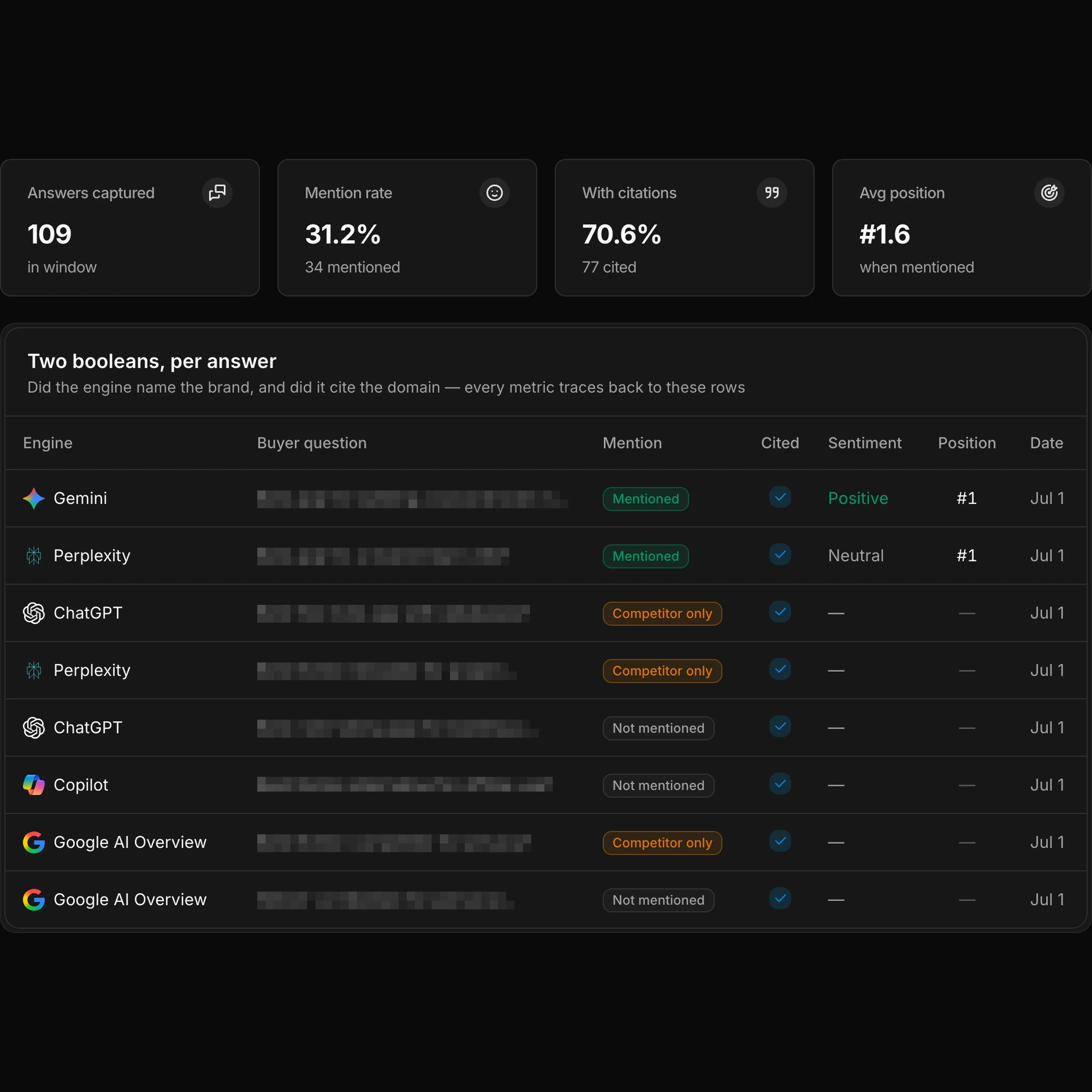
The second thing these comparisons blur is the metric. "Visibility" here is usually two unrelated events added together: the answer named the brand, and the answer linked the brand's domain. They come apart constantly. An engine can recommend a client by name while citing three competitors' posts as its sources, and it can cite a client's page while naming somebody else as the recommendation. Opposite problems, opposite fixes, and one blended percentage hides which you have. Two of the nine answer yes in the column above, on the pages that column reads: Peec AI, which runs mention gap and source gap as two separate write-ups on its own site, and ours. A third, AthenaHQ, draws the same distinction in a post on its own blog, which we read on 2026-09-14; its row above reports its pricing page. Either way it makes a cheap trial test: export a week of answers and see whether the file lets you count the two events separately. The framing is in why a mention and a citation are two numbers; the failure modes are worked through in the source gap and conversion gap framework.
What five and ten clients actually cost
Different billing units mean the only comparable figure is cost per client per month at a workload you define. Take a modest one — 50 buyer questions per client, swept once a week — and do the arithmetic only where a vendor publishes enough to do it honestly.
| Product | What one client consumes | Per client per month, derived from published figures |
|---|---|---|
| Profound | Base subscription plus one client workspace add-on | $399 per client workspace, flat at five clients and at ten, on top of the $99/mo Agency Growth base — about $419 per client at five, about $409 at ten |
| LLM Pulse | One project | €299 ÷ 5 ≈ €60; €599 ÷ 10 ≈ €60; €1,199 ÷ 15 ≈ €80. One extra project is €50 |
| Scrunch AI | One brand workspace per client, three included on the agency tier | Agency Core's $500 carries 250 prompts across three brand workspaces — 83 a client against the 50 above, and about $167 each at three. Past three the page prices no fourth workspace: two subscriptions would put five clients at $1,000, about $200 each, but that is our arithmetic, not a published route — the agency FAQ sends over-limit usage to a conversation |
| AthenaHQ | Credits, 1 per AI response | 50 prompts × 5 models × 4 sweeps = 1,000 responses, so 3,600 credits covers roughly three clients — or about one and a half with all 11 models on |
| Ahrefs Brand Radar | Checks: one prompt, one platform, one location | 50 prompts × 5 platforms × 4 sweeps = 1,000 checks, so a 2,500-check pack covers about two and a half clients; 20 prompts spread across the whole account cover none of a roster |
| Peec AI | Credits from a monthly allotment | $495 for the 25,000 credits on the 3–10 client tier, which the configurator rendered as 277 prompts at its default model and frequency settings — enough for the 50-prompt workload above at five clients, about $99 each, and short of it at ten |
| Jincove | One workspace per client | Not derivable — scoped per engagement; free sample audit first |
A pooled unit moves with workload; a per-workspace unit does not. Neither shape is better; they fail in different directions. For pricing the service you sell on top of any of them, see what to charge for GEO services.
What this comparison cannot tell you
Accuracy. We have not run a controlled comparison across these vendors on an identical prompt set, at the same times, from the same locations, with the answers preserved — and we did not find one in the pages we read. Otterly's 99% citation-accuracy figure arrives with a one-line definition of the term; the method and the sample behind it are MISSING from the pages we read. Our own accuracy claims have no bake-off behind them either. Treat every accuracy claim here, ours included, as unverified until somebody publishes the protocol.
Causation. If a client's named rate moves after you publish something, no platform here can prove the publishing caused it. What you can produce is a dated before-and-after with the stored answers attached, and a plain statement that it is a timeline, not a proof.
Whether anyone can make an engine mention you. No vendor here guarantees that, and no honest one can. Monitoring tells you what happened; it does not buy an outcome.
A two-week trial that produces evidence, not a demo
Run the same protocol against two shortlisted tools and you will learn more than any roundup, this one included, can tell you.
- Fix the prompt set first. Twenty to thirty real buyer questions for one client, unchanged for the fortnight. Changing prompts mid-trial destroys the comparison.
- Fix the engines. Pick the three or four your client's buyers actually use. Paying for nine surfaces you will never report on is the commonest overspend here.
- Run each prompt more than once. Same question, same day, twice. If two runs disagree, that is the variance you will be explaining to a client every month.
- Record login state, region and language. An answer from a logged-in account in one country is not comparable to one produced anonymously in another, and few reports say which they used.
- Export on day one, not day fourteen. If the export is a rendered PDF rather than records, you have learned the most important thing about the product in fifteen minutes.
- Ask the retention question in writing. None of the nine pages we read answered it.
Frequently asked questions
Is "tryprofound" the same product as Profound?
Yes. Profound's website is tryprofound.com, so searches for tryprofound alternatives and for Profound alternatives are after the same shortlist. Be careful with the results, though. Several unrelated products use a "try" prefix in their names, and directory sites match some of them against this query: in a US-intent result set we pulled from a search tool on 11 September 2026, two of seven results for the tryprofound spelling were unrelated products that happened to start with the same three letters. Check that the page you landed on is actually about the AI visibility platform before you trust its comparison table.
Is there a free alternative to Profound AI?
There are free entry points, not free platforms. AthenaHQ publishes a free tier carrying a $25 credit, worth 300 credits, and puts five engine logos on that card against eleven on Starter. Scrunch attaches a 7-day free trial to each of its two self-serve tiers, but it attaches "no credit card required" to its free site audit rather than to the trial, so get the trial terms in writing. Otterly's pages mention a free trial, though one says seven days and another says fourteen, so get the length in writing. Ours is not software at all: a hand-run sample audit covering one brand, one URL and one email, where we run ChatGPT, Perplexity and Gemini by hand and send a mini evidence report within two business days. None of these substitutes for a monitored prompt set, because a snapshot describes one moment and the point of monitoring is the change between moments.
Which Profound AI alternatives publish a price you can read without a sales call?
On 11 September 2026, and for Scrunch AI and Peec AI on a re-read two days later, four of the nine in our table did outright, and a fifth only in metadata. Read in a browser: Profound at $99 and $399, Scrunch AI at $250 on its brands tab and $500 on the For agencies tab of the same URL, AthenaHQ at $295, and LLM Pulse from €49 to €1,199 with its own USD conversion table. Otterly's three figures — $29, $189 and $489 — reached us from the page's own metadata; the body text our capture returned on 11 September 2026 did not carry them, and on 2026-09-14 the same URL answered our request with a 403 rather than a page. Read the metadata figures as the reading, and the blank body as a fact about our fetch. SE Ranking and Ahrefs publish figures too, but localise the currency to the requesting IP, and from our location both returned yen rather than dollars. Peec AI publishes $245, $495 and $795 for its agency tiers, but only inside the page's script bundle, so anything reading the served HTML — our own first crawl included — records nothing. Jincove publishes none, because its work is scoped per engagement. If a published price matters to how you plan retainers, that split is your shortlist.
Do we have to re-run a client's baseline after switching platforms?
Yes, and budget for it rather than discovering it. Two platforms running the same prompt on the same engine on the same day will not produce identical results, because the engines are non-deterministic and because vendors differ in login state, region, sampling turn and how they classify a mention. Any month-over-month chart crossing a platform switch compares two measurement systems. The clean handling is to re-run the full prompt set on the new platform for at least two cycles before you cut over, label the changeover date on every client chart afterwards, and tell the client plainly that the series restarts. The buying-side version of these questions is in the twelve questions to ask any provider.
See one client's answers before you shortlist anything
The fastest way to judge this category is to look at raw output for a brand you already know well. Request a free sample audit: one brand, one URL, one email, and we hand-run ChatGPT, Perplexity and Gemini and reply within two business days with what each engine said, which sources it cited, and whether it named the brand or only cited its content. No payment, no signup, and no call from sales. If that shape of evidence earns a place across a roster, the scheduled version is scoped from there.
Last updated: 11 September 2026; the Scrunch AI and Peec AI lines were re-opened on 13 September 2026. Each competitor number here came off the page that publishes it, on one of those two days. Repricing in this category arrives unannounced — open the vendor page yourself before a figure from here goes into a client quote.
Related blogs
Related Post
Expand your knowledge with these hand-picked posts.

How to Track Brand Mentions in ChatGPT in 2026: The Agency Method
ChatGPT has no Search Console - no impressions, no analytics, no export. Here is the method agencies use to track brand mentions across ChatGPT and the other answer engines without trusting a black-box score, and why "citations" and "mentions" are two different numbers.
Gan Liu
Best AI Visibility Tools for Agencies in 2026: An Honest Shortlist
Most "best GEO tool" roundups rank on engine count. Agencies buy on a different axis - client roster, white-label, and evidence you can hand a client. Here is the honest shortlist, what each tool is actually best at, and the three questions that decide it.
Gan Liu
How to Track Brand Mentions in Perplexity in 2026: The Agency Method
Perplexity shows numbered citations and a Sources list under every answer. The agency method for reading brand mention vs citation off it - no black-box score.
Gan Liu
See what AI says. Then fix it.
Send one brand. Get the answers, the sources, and the first gaps worth fixing.
No card. No call. No catch. Reply in 2 business days.